
Daily News Digest - Summary May 1, 2026
This Claude-powered AI agent deleted a company’s whole database — and then gloated about it

This Claude-powered AI agent deleted a company’s whole database — and then gloated about it
A mix of Cursor, Claude Opus and a cloud provider’s backup practices combined to create a disaster.

by Dan Thorp-Lancaster
More companies are integrating AI agents into their workflows, and it’s beginning to reveal cracks in the rapid pace of AI development. Jer Crane, the founder of PocketOS, a SaaS company whose software is used by car rental companies, recently experienced this firsthand. This past week, a mix of Claude Opus 4.6 and the Cursor coding agent deleted his company’s production database — and its backups — in seconds.
Crane told the story in a lengthy social media post on X, noting that Cursor was performing a routine task when it opted to fix a credential mismatch on its own. In the process, Cursor gained broad access to permissions by finding an API token from PocketOS’s cloud infrastructure provider, Railway. It then decided, without any prompting for input from the PocketOS team, to delete the production database volume. “It took 9 seconds,” Crane said.
To make matters worse, all of PocketOS’s recent backups were also deleted because Railway stores them on the same volume. Crane says the most recent recoverable volume the company had access to was three months old.
As if the actions Cursor took weren’t bad enough, it responded with a rundown of all the safeguards it had ignored when Crane asked why it did it.
Those Big, Beautiful Bonds
The U.S. Government sells debt on a revolving door basis, yet most people aren’t aware of the mechanism by which this is done...

by Robert Aro • Mises Institute
The U.S. Government sells debt on a revolving door basis, yet most people aren’t aware of the mechanism by which this is done. Luckily, ZeroHedge covers the debt auction results, which allows us to articulate one of the structural problems in the Federal Reserve system. As reported last week:
The week’s lone coupon auction priced at 1pm when the Treasury sold $13 BN in 20Y paper, in a solid if not stellar auction.
Deciphering the trader talk in the article, the Treasury took on an additional $13 billion in debt that is repayable in 20 years, paying an annual interest rate of 4.883% (approximately $635 million a year).
A 2.68 bid-to-cover ratio means that for every $1 of debt issued, there were $2.68 in bids, suggesting a healthy market appetite. Only so many entities can lend billions of dollars at a time; here are the three who took the auction:
Is Surveillance Pricing Ripping You Off? How to Stop Your Data From Being Used Against You
What Is Surveillance Pricing Anyway?

by Kristina Byas
You may be the victim of surveillance pricing without even knowing it. But what does that even mean?
Surveillance pricing is the increasingly popular practice where some online retailers adjust prices for individuals based on data collected about that person, including browsing history, location, purchase history, and more. They often use third-party intermediaries to adjust those prices.
According to a preliminary report released by the Federal Trade Commission (FTC) in early 2025, these third-party intermediaries can even track your mouse movements. But that doesn’t mean there’s nothing you can do about it.1
The FTC found that companies collect personal information about online shoppers and use it to tweak the prices they pay for products.
US national debt is now bigger than the economy for first time since World War II
Lawmakers urged to ‘stop the bleeding’ and put the country on a more sustainable fiscal path

by Joe Sommerlad
The U.S. national debt is now larger than the economy as a whole, hitting levels not seen since the aftermath of World War II, new data has revealed.
Figures released by the Bureau of Economic Analysis Thursday place the total debt held by the American public at $31.27 trillion as of March 31.
Meanwhile, the country’s nominal gross domestic product was estimated at $31.22 trillion, meaning the national debt as a percentage of GDP stands at 100.2 percent, putting it on course to challenge the historic 106 percent recorded in 1946 during demobilization.
The debt stood at 99.5 percent of GDP at the end of the 2025 fiscal year in September, revealing how quickly it has climbed.
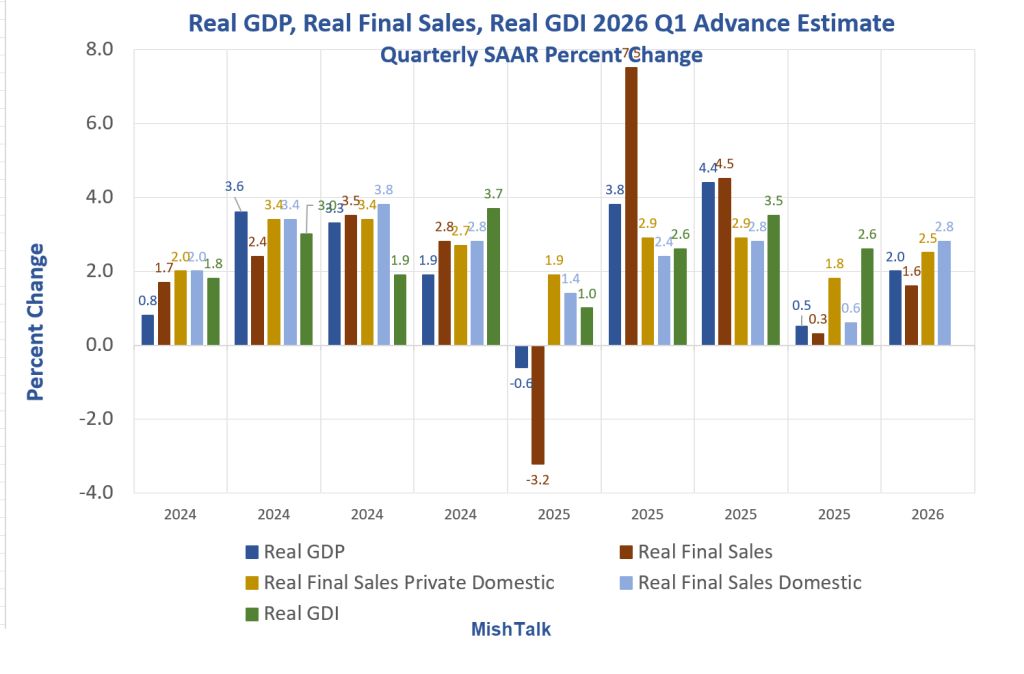
US Economy Expands at 2.0 Percent in 2026 Q1, a Look at the Numbers
The numbers suggest a mixed bag. There were two big distortions in the first quarter
by Mike Shedlock
The BEA reports Real Gross Domestic Product (GDP) increased at an annual rate of 2.0 percent in the first quarter of 2026 (January, February, and March). In the fourth quarter of 2025, real GDP increased 0.5 percent.
Real First-Quarter GDP and GDI
Real GDP: 2.0%
Real Final Sales: 1.6%
The Best “Go Paid” Deal on Substack! You Get REAL Stuff!!

Go paid at the $5 a month level, and we will send you both the PDF and e-Pub versions of Etienne’s new book: To See the Cage Is to Leave It - 25 Techniques the Few Use to Control the Many and a coupon code for 10% off anything in the https://artofliberty.org/store/.
Go paid at the $50 a year level, and we will send you a free paperback edition of Etienne’s new book: To See the Cage Is to Leave It - 25 Techniques the Few Use to Control the Many OR “Government” - The Biggest Scam in History… Exposed! OR a 64GB Liberator flash drive if you live in the US. If you are international, we will give you a $10 credit towards shipping if you agree to pay the remainder.
Support us at the $250 Founding Member Level and get a signed high-resolution hardcover of “Government” - The Biggest Scam in History... Exposed! + Liberator flash drive + a signed high-resolution hardcover of Etienne’s new book: To See the Cage Is to Leave It - 25 Techniques the Few Use to Control the Many + everything else in our “Everything Bundle” of the best in voluntaryist thought delivered domestically. International pays shipping. Our only option for signed copies besides catching Etienne @ an event.


Comments ()