
Eight pivotal facts about Covid-period excess mortality
Needed medical paradigm shift to centrality of physiological and psychological stress
Summary
Eight pivotal facts about Covid-period (2020-2025) excess mortality are described:
- Fact #1: The scale of excess all‑cause mortality during the Covid period was 0.13 % of population per year
- Fact #2: The Covid-period excess mortality was not caused by a spreading respiratory pathogen
- Fact #3: Most Covid-period excess mortality in young adults and the youth is not assigned to respiratory conditions (COVID-19)
- Fact #4: Excess mortality during the Covid period was highly heterogeneous, tied to imposed measures and medical protocols in specific jurisdictions and locations and in specific population groups
- Fact #5: The COVID-19 vaccine has harmed and killed many people
- Fact #6: Sharp peaks in excess mortality were temporally associated with rapid vaccine and booster rollouts
- Fact #7: Vaccination-status-discerned mortality studies show no statistically significant mortality-averting benefit or mortality- causing liability from COVID-19 vaccines
- Fact #8: There is a large systematic sex disparity in Covid-period excess mortality from main assigned causes, including (nominally COVID-19) respiratory disease
These empirical findings, based on extensive research, allow one to deduce the fundamental cause of Covid-period excess mortality.
All the excess mortality of the Covid period is inferred to arise from the many government assaults that produce deleterious health consequences in susceptible individuals via known biological processes involving sex-differentiated and age‑dependent extreme biological stress response (sustained or irreversible activation of the hypothalamic-pituitary-adrenal or HPA axis), leading to deaths assigned to respiratory conditions (“COVID-19”), circulatory conditions, gut conditions, etc., and to accidental self-harm associated with drug and alcohol use.
Here, the known said government assaults included: fear propaganda, mandates, measures, public-health responses, and medical assaults. The largescale and repeated medical assaults included: testing, diagnostic bias, imposed facial masking, confinement, isolation, denial of appropriate treatment, mechanical ventilation, sedation, experimental and improper treatments, and vaccination rollouts.
The main lesson from the Covid-period assault by governments is that physiological and psychological (biological) stress was overwhelmingly the dominant underlying cause of disease and early death. The violent government Covid campaign ― like any major structural societal disruption that removes resources, mobility, human contact, social status and purpose ― caused the excess morbidity and mortality that occurred in all age groups.
Fact #1: The scale of excess all‑cause mortality during the Covid period was 0.13 % of population per year
In their large study of 125 countries, Rancourt et al. (2024) concluded, among other things:
“The overall excess all-cause mortality rate in the 93 countries with sufficient data in the 3‑year period 2020-2022 is 0.392 ± 0.002 % of 2021 population [0.13 % of 2021 population per year, on average for each year in the 3-year period] [...]
Our calculated excess mortality rate (0.392 ± 0.002 %) corresponds to 30.9 ± 0.2 million excess deaths projected to have occurred globally for the 3-year period 2020-2022, from all causes of excess mortality during this period. [...]
We understand the Covid-period mortality catastrophe to be precisely what happens when governments cause global disruptions and assaults against populations. We emphasize the importance of biological stress from sudden and profound structural societal changes and of medical assaults (including denial of treatment for bacterial pneumonias, repeated vaccine injections, etc.). We estimate that such a campaign of disruptions and assaults in a modern world will produce a global all-ages mortality rate of >0.1 % of population per year, as was also the case in the 1918 mortality catastrophe.”
The yearly global excess all-cause mortality rate during the 2020-2022 Covid period (0.13 % of population) is less than one tenth of the global average death rate per year of 1.4 % of population, which corresponds to the mean global life expectancy at birth (e0) of 71 years. This yearly excess all-cause mortality during the 2020-2022 Covid period (0.13 % of population) corresponds to reducing e0 from the global average of 71 years to approximately 65 years. For the relationship between life expectancy and death rate, see Liang et al. (2023).
This gives the scale of the excess all-cause mortality in the Covid period.
Fact #2: The Covid-period excess mortality was not caused by a spreading respiratory pathogen
The hypothesis that Covid-period (all-ages) excess all-cause mortality was primarily due to or driven by a spreading pandemic-causing viral respiratory pathogen is specific and can be tested. It has been tested. It is incompatible with the observed excess mortality. It is disproved.
Hickey et al. (2025) used high-resolution all-ages excess all-cause mortality data (expressed as P-scores) for Europe and the USA to conclusively show that the geotemporal mortality patterns during the early months of the declared SARS‑CoV-2 pandemic are incompatible with the paradigm of a spreading viral respiratory disease. Without my now repeating the arguments (but see Fact #4), they concluded:
“This means that the paradigm that a spreading viral respiratory disease caused the excess mortality during Covid is false. The said paradigm is disproved by empirical observations of high-resolution (weekly-monthly, county-region) geotemporal variations of age and frailty adusted excess mortality (P-score) on two continents in the Northern Hemisphere. Instead, the excess mortality appears to be entirely iatrogenic and induced by the imposed so-called pandemic response.”
Rancourt et al. (2024) studied 125 countries extensively and (without my now repeating the arguments) likewise concluded:
“The spatiotemporal variations in national excess all-cause mortality rates allow us to conclude that the Covid-period (2020-2023) excess all-cause mortality in the world is incompatible with a pandemic viral respiratory disease as a primary cause of death. This hypothesis, although believed to be supported by testing campaigns, should be abandoned.”
This was already indicated in the data from the first months of the declared pandemic (Rancourt, 2020). Furthermore, there was essentially no detected excess all-cause mortality anywhere in the world prior to the arbitrary administrative announcement of a pandemic on 11 March 2020 when excess mortality started (Rancourt, 2020; Rancourt et al., 2024; Hickey et al., 2025).
Therefore, Covid-period excess mortality cannot be due to a presumed viral respiratory pandemic. It must be understood otherwise.
There was no pandemic of a spreading virulent death-causing viral respiratory pathogen. As far as mortality is concerned, whether there were circulating viruses and their variants is an irrelevant academic question. Also, note that the viral respiratory pandemic narrative relies on complex technology and methods prone to ambiguity of interpretation.
Fact #3: Most Covid-period excess mortality in young adults and the youth is not assigned to respiratory conditions (COVID-19)
Although Covid-period excess all-cause mortality in the elderly often presents itself as temporal peaks essentially equal to or comparable to temporal peaks of mortality assigned as COVID-19 (i.e., mortality associated with respiratory conditions), in jurisdictions in which both all-cause mortality and assigned COVID-19 deaths are recorded by age group, it is generally true that by far most Covid-period excess all-cause mortality (inferred from the pre-Covid-period historic trend of all-cause mortality, by age group) in young adults and the youth is not assigned to respiratory conditions (COVID-19) (Mulligan and Arnott, 2022; Ruhm, 2023, their Figure 3A).
In other words, young people did not have Covid-period excess mortality mainly associated with respiratory conditions as underlying causes (COVID-19).
Figure 1 (four panels) illustrates this for the Canadian province of Alberta. Here, excess all-cause mortality (xACM, orange, based on reference years 2015 through 2019) is compared to mortality assigned to COVID-19 (green), by year, for each of the age groups 65+, 45-64, 18-44 and 0-17 (top to bottom panels, as indicated) (Source: Rancourt, 2025a).
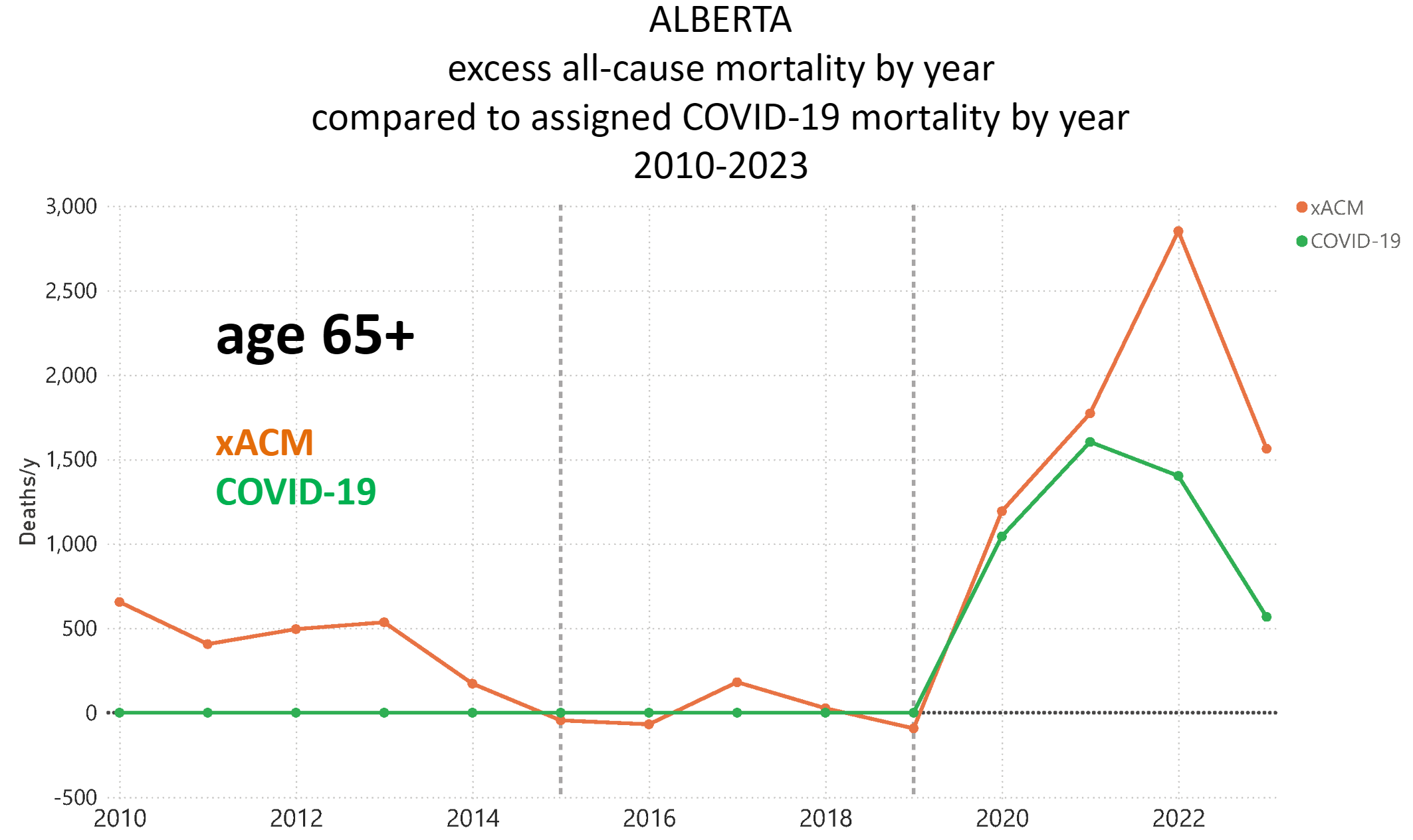
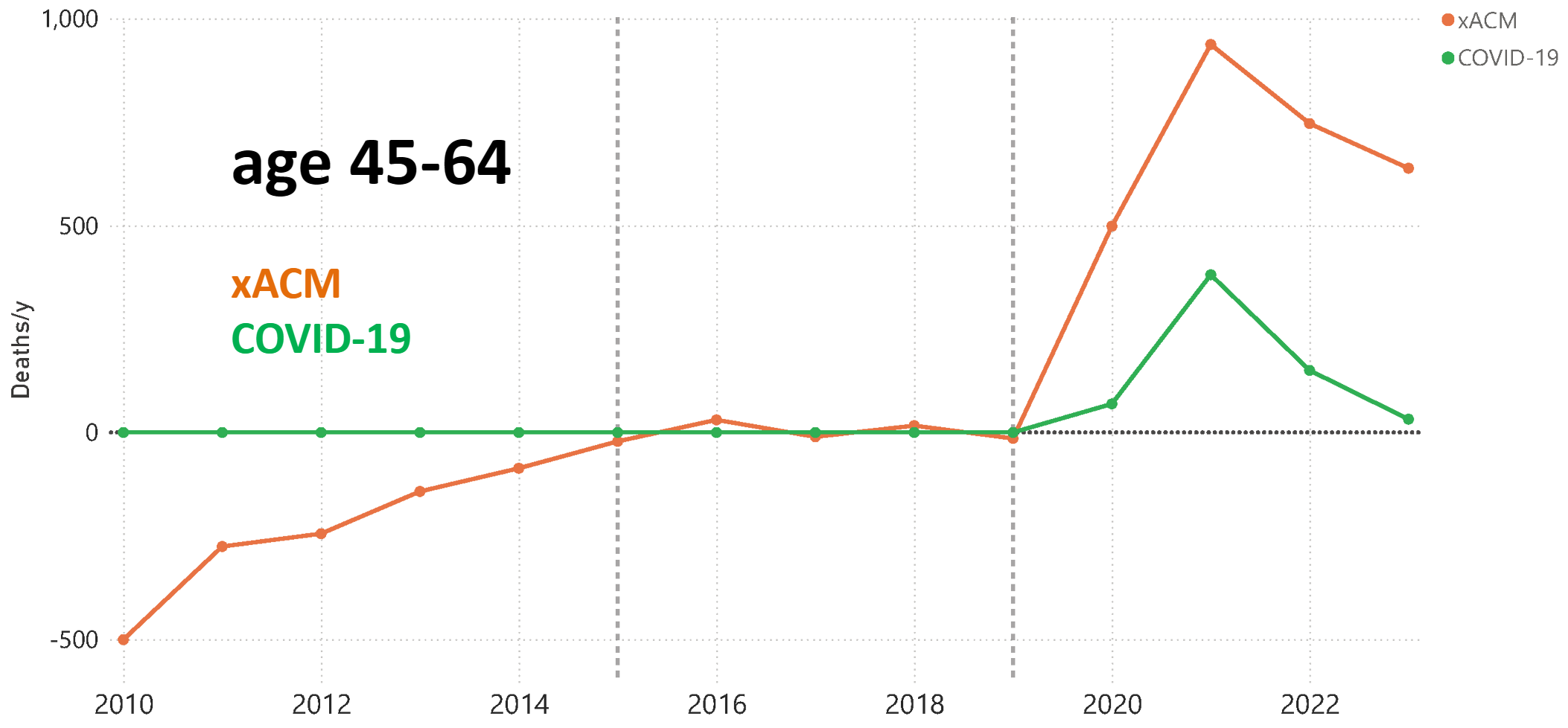
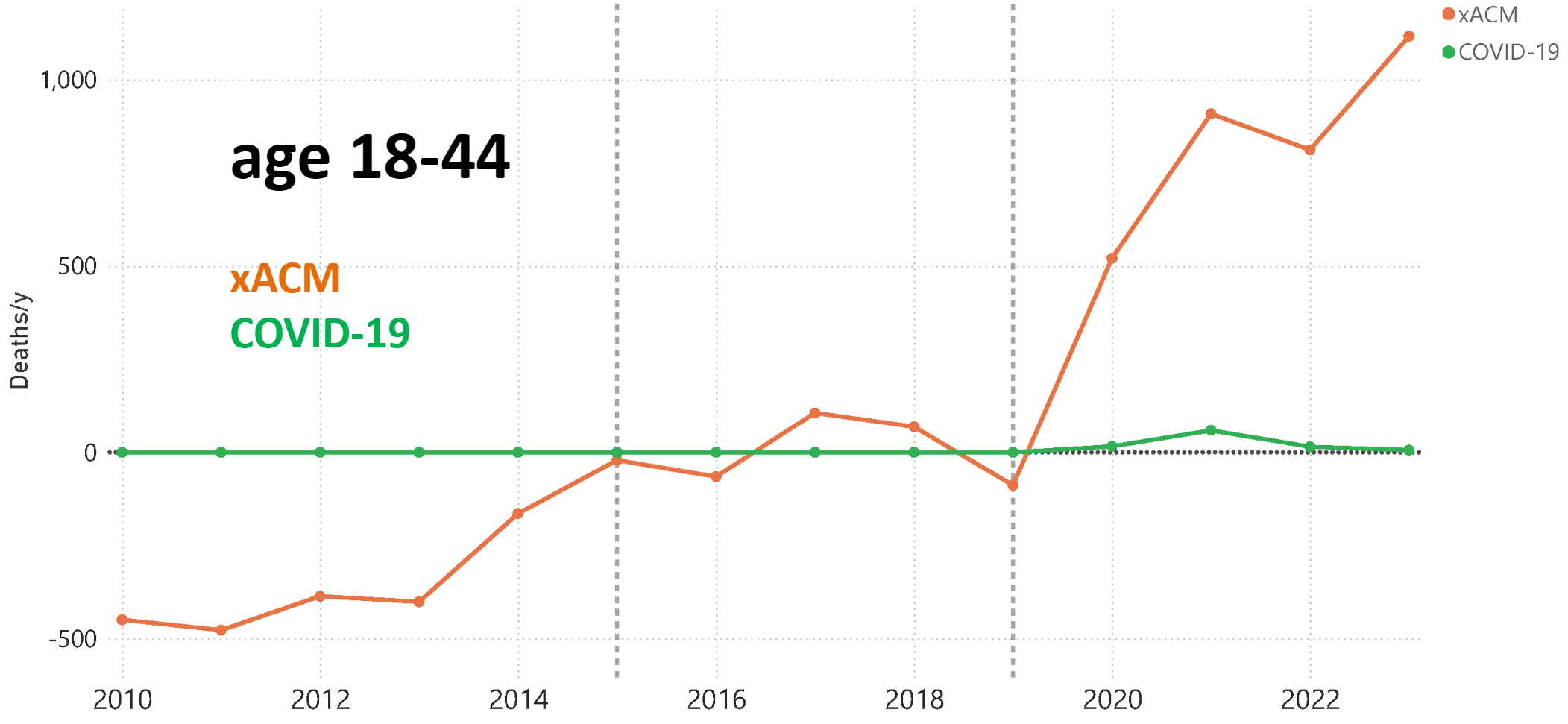
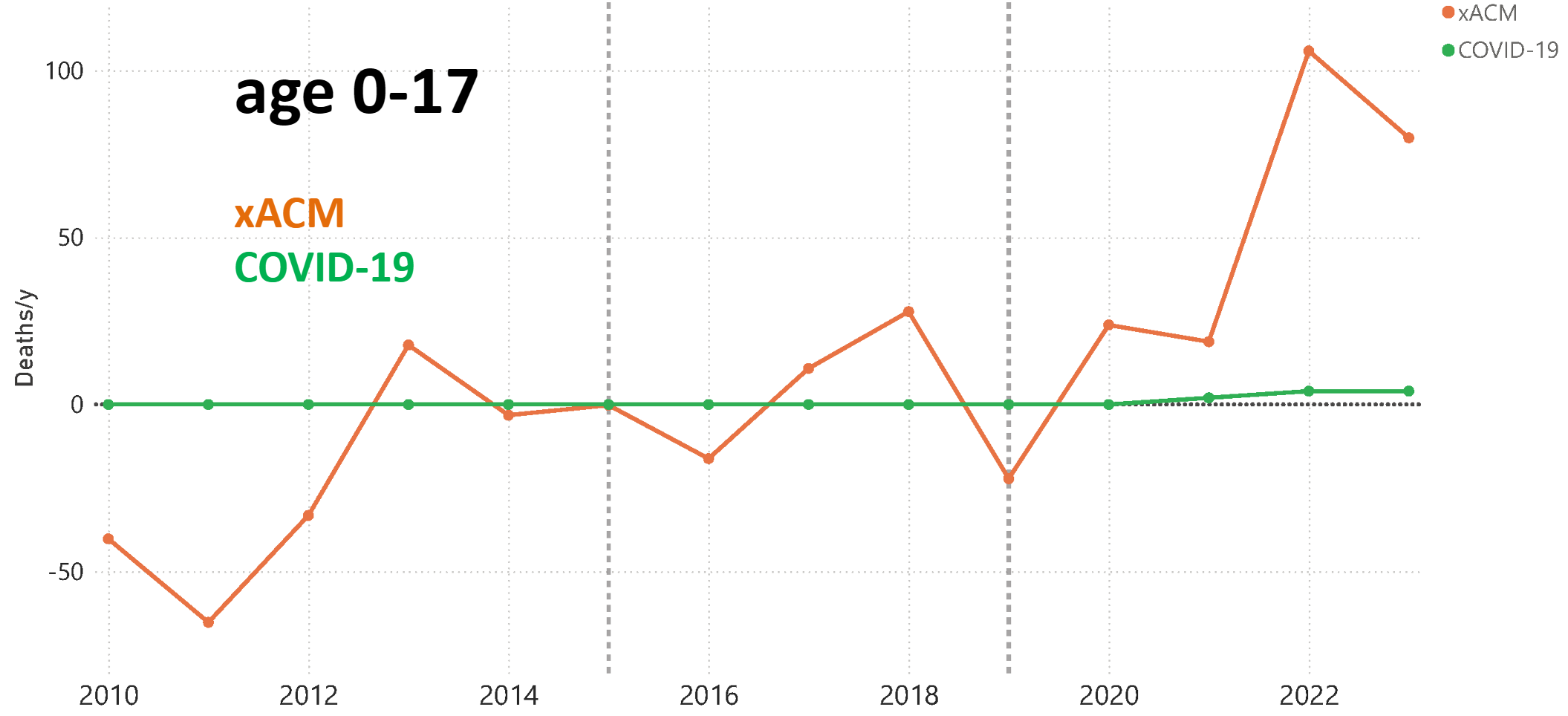
Figure 1: (Four panels) Yearly excess all-cause mortality (xACM, orange, based on reference years 2015 through 2019) compared to yearly mortality assigned to COVID-19 (green), for each of the age groups 65+, 45-64, 18-44 and 0-17 (top to bottom panels, as indicated), for the Canadian province Alberta. (Source: Rancourt, 2025a.)
Alberta is a case in which young-person Covid-period excess all-cause mortality is particularly large, and is related in part to accidental fatal opioid overdoses. Particularly large young-person Covid-period excess all-cause mortality (with a sudden step‑wise increase soon after a pandemic was announced on 11 March 2020) is not uncommon, especially for males, in many Western jurisdictions, associated with drug and alcohol-related accidental deaths. In general, young-person Covid‑period excess all-cause mortality is always significantly larger than young‑person COVID-19-assigned mortality in the same jurisdiction.
This is also true of all-ages (total for all ages) Covid-period excess all-cause mortality. Rancourt et al. (2024) showed that in 91 countries with sufficient data for 2020 through 2022 the ratio of all-ages excess all-cause mortality to all-ages assigned-COVID-19 mortality was large, with a country-wise mean value of 2.2 (median 1.55) and high values up to more than 6 (their section 4.13, their Figure 22).
Fact #4: Excess mortality during the Covid period was highly heterogeneous, tied to imposed measures and medical protocols in specific jurisdictions and locations and in specific population groups
If we accept the pandemic idea as presented in the dominant view, then infection should spread from the source (in China) outward, via local, regional and international transportation and contacts, along major flight paths, from urban centres to rural areas, distributing death to all exposed and sufficiently vulnerable individuals on its inevitable path (see Hickey et al., 2025, for discussion of state‑of-the-art model predictions for the Covid period).
Actually, nothing like that happened. Rare extreme hotspots of excess mortality separated by many thousands of kilometres were often synchronous and their spatial distributions were unnaturally (according to the dominant view) heterogeneous. Untouched populations neighboured devastated patches, and there were exceedingly large differences in inferred infection fatality ratios for comparable and nearby populations (Hickey et al., 2025). In Italy, for example, Milan had one of the largest documented peaks of early Covid-period excess mortality and Rome (with different hospital and public-health protocols) had essentially no early Covid-period excess mortality (Hickey et al., 2025). The same sort of heterogeneous behaviour was observed at the state level in the USA (Rancourt et al., 2021, 2022a). This also occurred at the country level on the global scale (Rancourt et al., 2024). Canada also shows the same spatial heterogeneity and ties to measures, institutions and conditions, by province and by region (Rancourt, 2025a).
The types of imposed measures and medical protocols that were synchronously associated with significant surges in excess mortality in specific jurisdictions and locations and in whole or specific population groups included:
- Suddenly imposed lockdowns and stay-at-home orders (Johnson and Rancourt, 2022)
- Suddenly imposed aggressive medical protocols (Hickey et al., 2025)
- Military-style house-to-house intervention campaigns (Rancourt et al., 2023a)
- Aggressive first-rollout COVID-19 vaccination campaigns (Rancourt, 2022, case of India targeting the vulnerable)
- Rapid COVID-19 vaccine booster rollouts (Rancourt, 2025b)
- Rapid COVID-19 testing rollouts (Rancourt, 2025b, at p. 108)
- Rapidly-applied so-called vaccine equity campaigns (Rancourt et al., 2022a) and re-vaccination campaigns (Fast et al., 2021; Mbaeyi et al., 2021)
- Sudden loss of employment or of financial assistance (Rancourt, 2025a, 2025b)
I provided graphical examples in recent presentations (Rancourt, 2025a, 2025b). A few are shown below.
Figure 2 shows three successive sharp peaks in age 85+ excess all-cause mortality (xACM, blue line) immediately following each of three sudden increases (vertical dashed line and two vertical grey bands) in “protection of the elderly” policy measures (red line), for Canada (Source: Rancourt, 2025b, at p. 85).
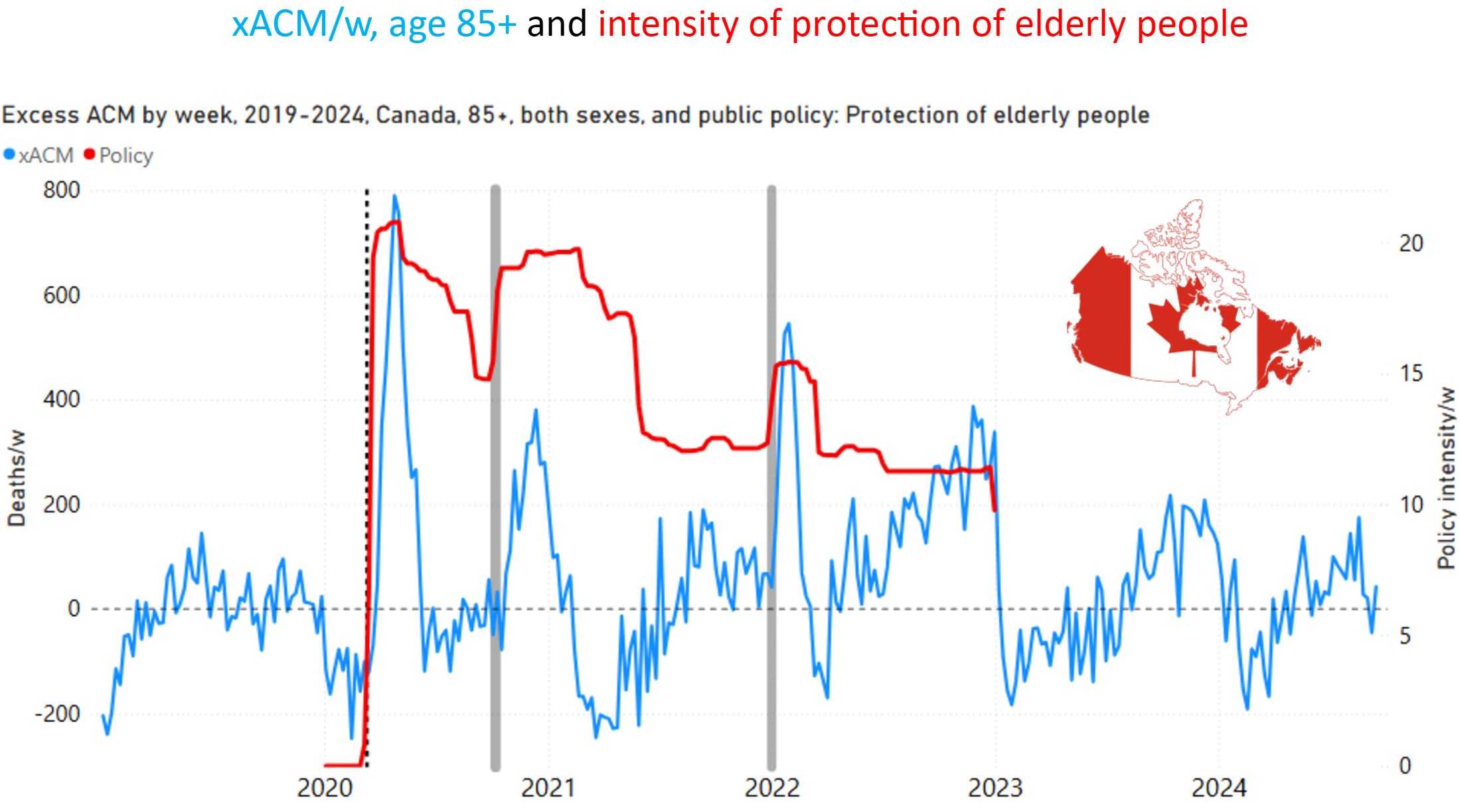
Figure 2: Age 85+ excess all-cause mortality (xACM, blue line) compared to a standard “protection of the elderly” policy measure (red line), by week, for Canada. (Source: Rancourt, 2025b, at p. 85.)
Figure 3 shows an unprecedented and sharp peak (red asterisk, blue line) of all‑cause mortality in the 2021-2022 Southern-Hemisphere summer, in Australia, which is synchronous with Australia’s first COVID-19 vaccine booster rollout (black line) (Source: Rancourt et al., 2022b; Rancourt, 2025b, at p. 104). There are many such striking booster-mortality peak associations, around the world (e.g., Rancourt et al., 2023a; Rancourt, 2025b).
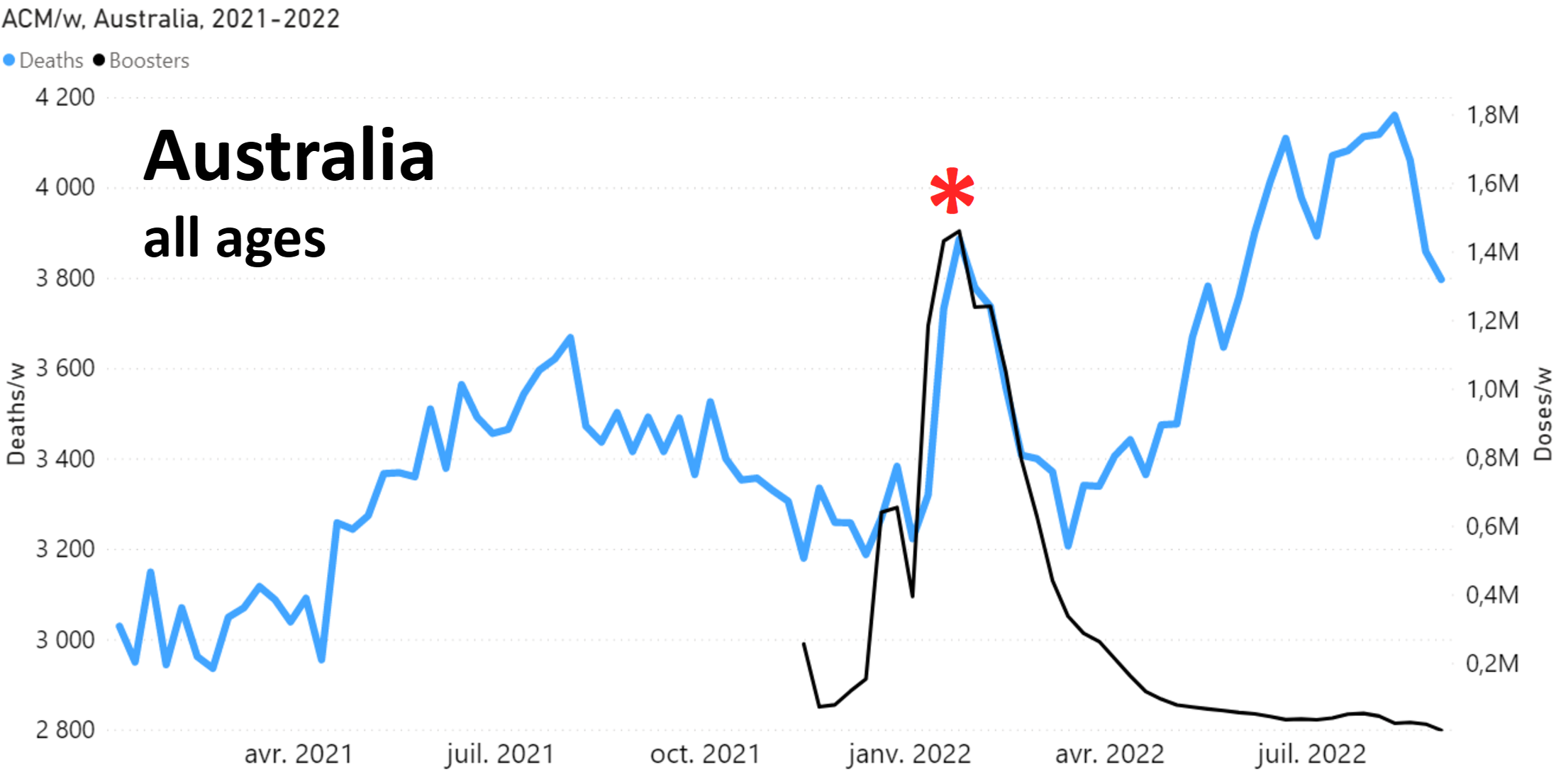
Figure 3: All-cause mortality (Deaths/w, blue line) compared to the first COVID-19 vaccine booster rollout, by week, for Australia. (Source: Rancourt, 2025b, at p. 104; adapted from Rancourt et al., 2022b.)
Figure 4 shows a fall 2021 peak (blue line, black dot) in excess all-cause mortality for ages 80+ in Netherlands compared to COVID-19 vaccination rollouts (for all ages, all doses, pink line, top panel) and to COVID-19 testing rollouts (for all ages, all tests, black line, bottom panel). Here, we see that whereas a large and sharp January-2022 peak in vaccination rollout mostly follows the excess mortality peak, the said mortality peak (black dot) is preceded by and synchronous with a sharp testing rollout peak.
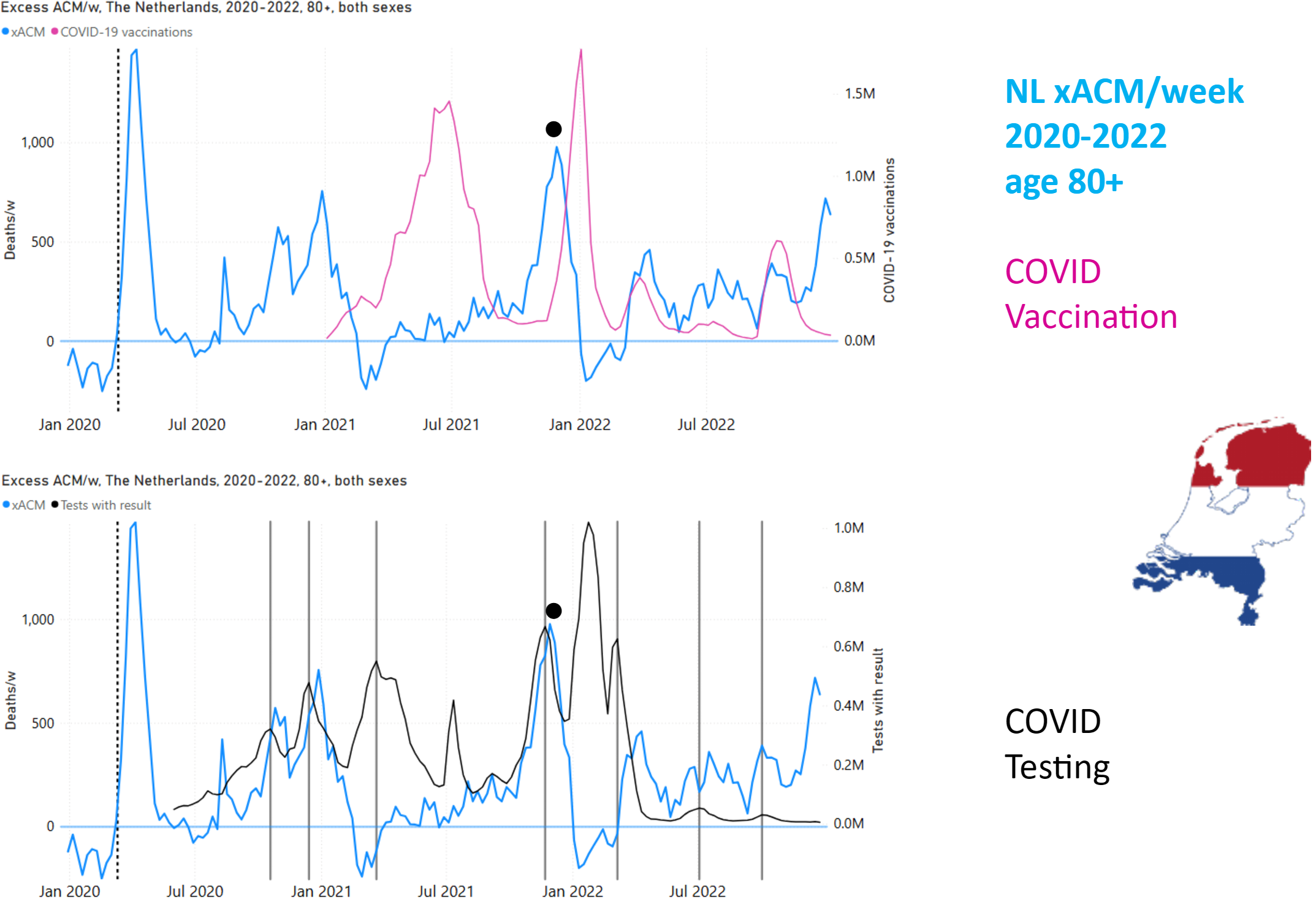
Figure 4: (Two panels) Excess all-cause mortality (light blue curves, left y-axes) for 80+ year olds in Netherlands compared to COVID-19 vaccination rollouts (for all ages, all doses, pink line, right y-axis, top panel) and to COVID-19 testing rollouts (for all ages, all tests, black line, right y-axis bottom panel). The black dot indicates the excess all-cause mortality peak of interest discussed in the text. (Source: Rancourt, 2025b, at p. 108.)
Fact #5: The COVID-19 vaccine has harmed and killed many people
Contrary to the industry mantra that the COVID-19 vaccine is “safe and effective”:
- the vaccine cannot be “safe” because it has unquestionably harmed and killed many people (see references below), and
- the vaccine cannot be “effective” because the Covid-period excess mortality was not caused by a spreading respiratory pathogen (Rancourt, 2020; Rancourt et al., 2024; Hickey et al., 2025).
There is clinical and pathological proof that the COVID-19 vaccine has caused harm and death in many people. For example, in the following sources:
- Detailed autopsy studies (e.g., Choi et al., 2021; Edler et al., 2021; Schneider et al., 2021; Sessa et al., 2021; Gill et al., 2022; Mörz, 2022; Murata et al., 2022; Suzuki et al., 2022; Takahashi et al., 2022; Tan et al., 2022; Yeo et al., 2022; Yoshimura et al., 2022; Chaganti et al., 2023; de Boer, Crawford, Parsons, 2023; Esposito et al., 2023; Hulscher et al., 2023, 2024, 2025; Jeon et al., 2023; Manu, 2023; Nushida et al., 2023; Onishi et al., 2023; Palmer et al., 2023; Schwab et al., 2023; Souza et al., 2024; Koizumi and Ono, 2025; Mead et al., 2025; Pakanen et al., 2025; 51 scholarly works curated by CoVerse, 2026),
- Adverse effect monitoring (Rose and McCullough, 2021; Hickey and Rancourt, 2022; Johnson et al., 2026),
- Studies of vaccine-induced pathologies (e.g., Goldman et al., 2021; Kuvandik et al., 2021; Turni and Lefringhausen, 2022; Edmonds et al., 2023; Wong et al., 2023),
- Histopathology and immunohistochemical staining of skin biopsy specimens (Sano et al., 2023),
- Secondary analysis of serious adverse events reported in placebo-controlled, industry phase III randomized clinical trials (e.g., Fraiman et al., 2022),
- More than 1,250 peer-reviewed publications about COVID-19 vaccine adverse effects (React 19, 2022),
- Updated: 3,752 peer-reviewed publications about COVID-19 vaccine adverse effects, according to a systematic literature survey ending 1 May 2025 (React 19, 2025),
- Updated: 4,551 peer-reviewed publications about COVID-19 vaccine adverse effects, to date (19 April 2026) (React 19, 2026), and
- The known vaccine injury compensation programs of states worldwide, which include death resulting from the COVID-19 vaccines (Mungwira et al. 2020; Wood et al., 2020; Crum et al., 2021; Kamin-Friedman and Davidovitch, 2021), where Japan, Canada and the UK have granted compensation for COVID‑19 vaccine induced deaths (The Japan Times, 26 July 2022; Corbett, 6 September 2022; Wise, 2022).
Therefore, there can be no reasonable doubt that the COVID-19 vaccine causes harm and death to many people.
Furthermore, regarding adverse effect monitoring and safety signal detection in the USA, leaving aside institutional and health-care-provider biases not to report adverse effects (Garcia-Abeijon et al., 2023), there was blindness by design at the Food and Drug Administration (FDA) in the data mining algorithms that were implemented in connection with the Vaccine Adverse Event Reporting System (VAERS) (Johnson et al., 2026).
A recent study regarding mRNA-vaccine-induced cardiac adverse effects (using an animal model) showed that the vaccine toxicity occurs directly from the bio‑distributed cationic lipid nanoparticles and in particular not from spike protein, and that the adverse effect is stress mediated (Mori et al., 2026). Gutschi (2026) has pointed out the relevance of this study to human health, stress and age.
Fact #6: Sharp peaks in excess mortality were temporally associated with rapid vaccine and booster rollouts
Irrespective of whether one considers a rapid COVID-19 vaccine or booster rollout to be mainly a disruptive measure causing fatal physiological stress in institutionalized individuals or mainly the injection of a toxic substance that can cause death, it is undeniable that there are many examples of striking temporal associations between peaks in Covid-period excess all-cause mortality and peaks of vaccination (especially booster) rollouts, sometimes with successive such correlated peaks, corresponding to successive vaccine doses, in the same jurisdiction (country or region) (Rancourt, 2022, 2025a, 2025b; Rancourt et al., 2022a, 2022b, 2023a, 2023b). Figure 3 is one of many examples.
This does not mean that all large sudden surges or peaks of all-cause mortality are coincident with rapid vaccine rollouts, as stressed in the “Fact #4” section. Rather, it means that there are many examples of close temporal associations between COVID-19 vaccine rollouts and peaks in excess all-cause mortality.
The said close temporal associations are systematic with age, in which excess mortality per number of injections administered to the age group increases exponentially with age, doubling every additional 4-5 years in age (Rancourt et al., 2023a, their Figure 17; Rancourt et al., 2023b, their Figure 3).
These results led my collaborators and I to hypothesize that a corresponding fatal vaccine toxicity (age dependent, per injection) was acting, and this gave some 17 million calculated global vaccine deaths for all ages by 2023 (Rancourt et al., 2023a, 2023b; Rancourt, 2023). That hypothesis of direct vaccine fatal toxicity of this magnitude, although compelling, is incorrect.
Although this apparent toxicity (1 death per 800 injections, averaged over all ages, averaged over all dose types; Rancourt et al., 2023a) is much larger than the toxicity inferred from adverse effect surveillance (Hickey and Rancourt, 2022, their Table 1), we expected that it might be born out by vaccination-status-discerned all-cause mortality data. That is not the case, as described in the next section.
Fact #7: Vaccination-status-discerned mortality studies show no statistically significant mortality-averting benefit or mortality-causing liability from COVID-19 vaccines
A robust way to search for, confirm or disprove a large fatal toxicity of the COVID-19 vaccine (such as 1 death in 800 injections, averaged for all ages, as inferred from the correlation studies described above under “Fact #6”) is to analyze all-cause mortality in a large population while discerning those decedents that had been vaccinated from those that had never been injected with the COVID-19 vaccine prior to death. This is called vaccination-status-discerned all‑cause mortality. It can also be cause-specific mortality. The word “mortality” implies that it is for a large population.
There are now thousands of vaccination-status-discerned mortality studies (so‑called observational studies) that compare vaccinated and unvaccinated mortality rates in order to calculate positive (life saving benefit) or negative (death causing liability) COVID-19 vaccine effectiveness (VE). All such vaccination-status-discerned mortality studies suffer from potential and unavoidable biases that invalidate findings of large positive VE (Hoeg et al., 2023; Hulme et al., 2023).
In general, observational studies of all-cause mortality have not shown any life‑saving benefit from COVID-19 vaccination. This is amply demonstrated in quantitative critiques of counterfactual calculations (Rancourt, 2025c; Rancourt and Hickey, 2023, 2025; Rancourt et al., 2022c). Large positive VE values inferred from clinical studies are unambiguously false.
Most of the said biases in observational studies of vaccine impact have been identified and reviewed by Agampodi et al. (2024). I note that the list of Agampodi et al. (2024, their Table 1) is missing two important sources of potential bias:
- A healthy vaccinee bias in which clinicians and treating physicians decide not to vaccinate frail, sick or dying patients, as a point of professional ethics and/or following best-practice guidelines, because of the known and unavoidable challenge from vaccination.
- A misclassification bias in which injected persons are taken to be “unvaccinated” for a time period following injection (typically two weeks or so) because of the presumed time for vaccination-induce immunity to be established. This approach would incorrectly circumvent the vaccination adverse effects immediately following injection. Related artifacts in some government (UK) reporting are raised by Neil et al. (2022) and addressed by Morris (2022).
Healthy vaccinee bias is often large in vaccination-status-discerned all‑cause mortality studies, even after correcting for confounding factors such as age, sex, race and ethnicity, and data-source site. For example Xu et al. (2021, 2023) report adjusted relative risk (aRR) values typically as low as 0.35 for non‑COVID-19 mortality, which would assign extraordinary life-saving benefits from COVID-19 vaccination for all underlying causes of death. The correct approach is to interpret such results as a clear indication of a large healthy vaccinee bias, as many researchers have acknowledged.
However, the known and anticipated biases would not be significant enough to mask very large negative VE (i.e., fatal toxicity) of the COVID-19 vaccine inferred from the correlation studies described above under “Fact #6” (such as 1 death in 800 injections, averaged for all ages, and 1 death in 20 injections of the oldest recipients). The said very large fatal vaccine toxicity would be apparent in vaccination-status-discerned all-cause mortality studies, irrespective of residual or persistent biases.
The following vaccination-status-discerned all‑cause mortality studies show that the large fatal toxicity of the COVID-19 vaccine inferred from the correlation studies described above under “Fact #6” (1 death in 800 injections, averaged for all ages, and 1 death in 20 injections of the oldest recipients) are not validated. The said large fatal toxicity of the COVID-19 vaccine is not confirmed in any vaccination-status-discerned study or data that I have found:
- Aarstad (2026): UK.
- Acuti Martellucci et al. (2025): Italian province.
- Alessandria et al. (2025): UK data by age group.
- Baker et al. (2023): USA, hospital patients.
- Bakker et al. (2025): Netherlands.
- Ben-USMortality (2024b): New Zealand.
- Butt et al. (2023): Qatar.
- Dahl et al. (2026): Norway. (see discussion by Ben-USMortality, 2024a)
- Furst et al. (2024): Czech data, insurance companies. (with demonstrated healthy vaccinee bias)
- Morris (2022): UK data by age group.
- Sars2.net (2024): Czech data.
- Semenzato et al. (2025): France (long-term mortality, age 18-59).
- Vencalek et al. (2025): Czech data.
- Xu et al. (2024): USA (December 14, 2020, through August 11, 2021).
As striking as the correlations are between excess all-cause mortality peaks and vaccine and booster rollouts (Fact #6), they do not arise from the fatal vaccine toxicity itself. That hypothesis is disproved. The fatal vaccine toxicity itself, although real and proven (Fact #5), is too small to be evident in observational studies of population-scale mortality, in circumstances reported to date.
Fact #8: There is a large systematic sex disparity in Covid-period excess mortality from main assigned causes, including (nominally COVID-19) respiratory disease
Mortality during the Covid period, including COVID-19-assigned mortality, follows two universal features of human mortality in developed societies.
First, it follows the Gompertz law of mortality. That is, it follows an exponential increase of mortality risk with age, with a doubling time of approximately 7 or 8 years in age (Bauer et al., 2021, their Figure 2, for 16 countries; Rancourt et al., 2024, their Figure 49, for 25 European countries).
Second, there is a significant and systematic larger mortality rate for males compared to females (M > F), in all age groups at post-infant ages, for all-cause mortality and for mortality associated with major underlying causes of death, including COVID-19-assigned death (Bauer et al., 2021, their Figure 2; Ramirez-Soto et al., 2021; Rancourt et al., 2021, their Figure 33; Rancourt et al., 2024, their Figure 49 and Figure 50).
There is also such a M > F sex difference in overall Covid-period excess all-cause mortality rate, being significantly and systematically larger for males (Rancourt et al., 2024, their Figure 50, in each of 2020, 2021 and 2022).
When the said Covid-period excess all-cause mortality is expressed as a P-score (i.e., divided by the expected mortality, and thus adjusted for country-wise, age-wise and sex-wise mortality), there is no significant systematic sex difference, the male and female values are not significantly and systematically different, are essentially the same at all ages, in each of 2020, 2021 and 2022 (Rancourt et al, 2024, their Figure 51, for 25 European countries).
These facts are important because they suggest that both Covid-period excess all-cause mortality and COVID-19-assigned (respiratory) mortality are caused by essentially the same mechanism(s) that cause human mortality and limited life expectancy, in males and females, rather than being associated with a specific new and deadly pathogen. The intensity of the said same cause would of course depend on the country-specific circumstances and events (Rancourt, 2025a, 2025b, for overviews).
Interpretation / Discussion
There was large excess mortality everywhere that the Covid campaign was imposed by governments.
At the fundamental level, the features of mortality and excess mortality during the Covid period (Fact #8: exponential with age, M > F sex difference) are biological, having nothing significant to do with any new pandemic-causing pathogen, as I argue below. (Male and female infection rates (cases) are comparable, if anything larger for females, whereas calculated infection fatality rates are much larger for males (Ramírez-Soto et al., 2021), in every age group).
The exponential increase of mortality with age is a fundamental consequence of life itself in complex organisms with vital organ systems (Rutenberg et al., 2018; Flietner et al., 2025).
The M > F sex difference in mortality is universal in post-WWII developed countries and is certainly primarily biological, as argued below. The following are graphs showing some compelling features of the phenomenon.
Figure 5 shows the persistent sex difference in life expectancy at birth (e0) (F ‒ M, typically 5 years), 1950-2017, in regions and country groupings around the world (GBD, 2018, their Figure 8).
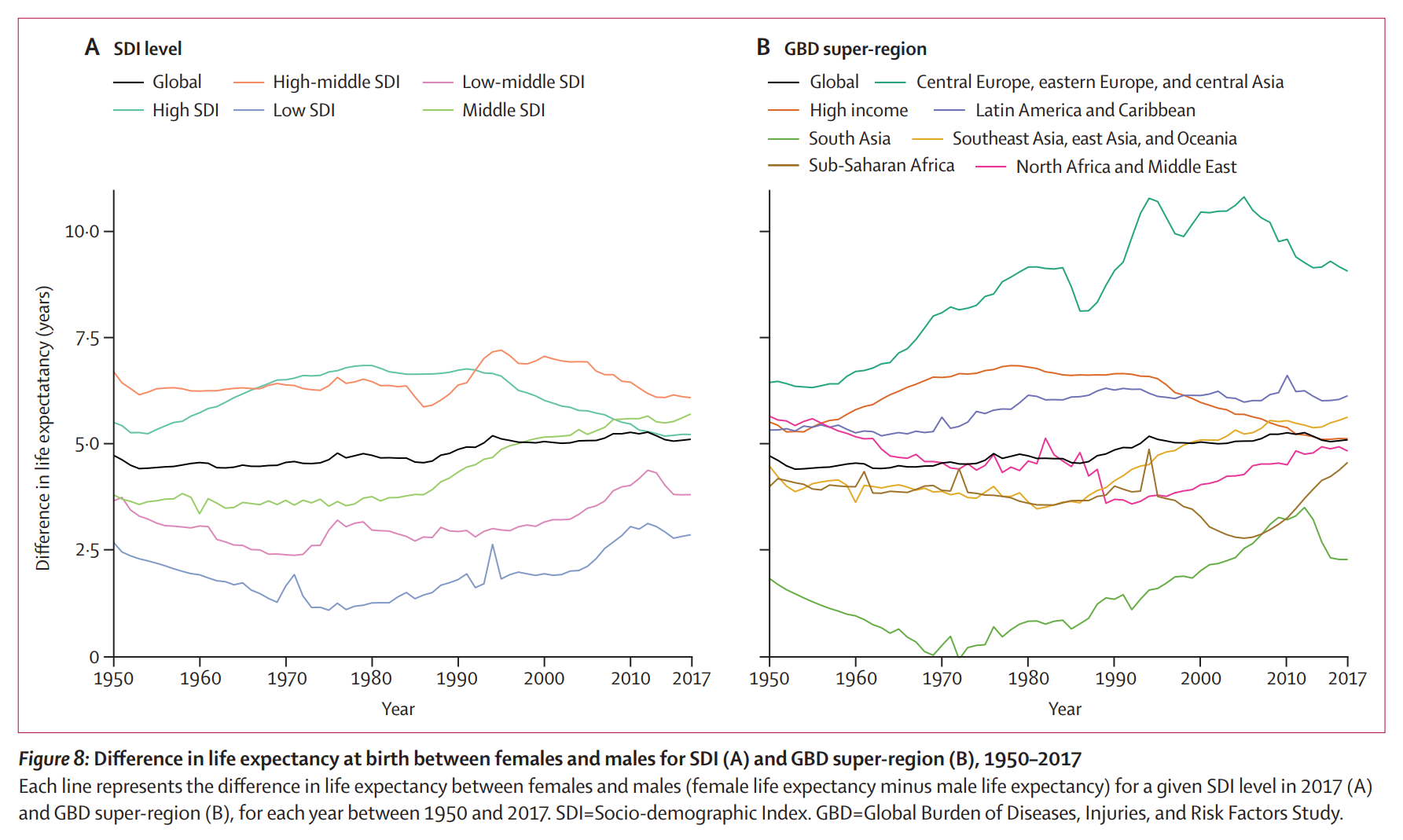
Figure 5: Figure 8 from GBD (2018). Sex difference in life expectancy at birth (e0) (F ‒ M), 1950‑2017, in regions and country groupings around the world.
The systematically longer life expectancy for females (Figure 5) means that mortality rates (all-cause mortality per year per population of persons of the given sex) are always larger for males than for females. This is true at all post‑infant ages, and it is also true for each of the main attributed causes of death.
Figure 6 shows age-standardized cancer mortality rates (per 100k population) for males and females, 2023, in several countries (OECD, 2025, their Figure 2.5). The higher cancer-assigned mortality rate for males is a systematic and general feature, for all ages and for each age > 40 or so (not shown).
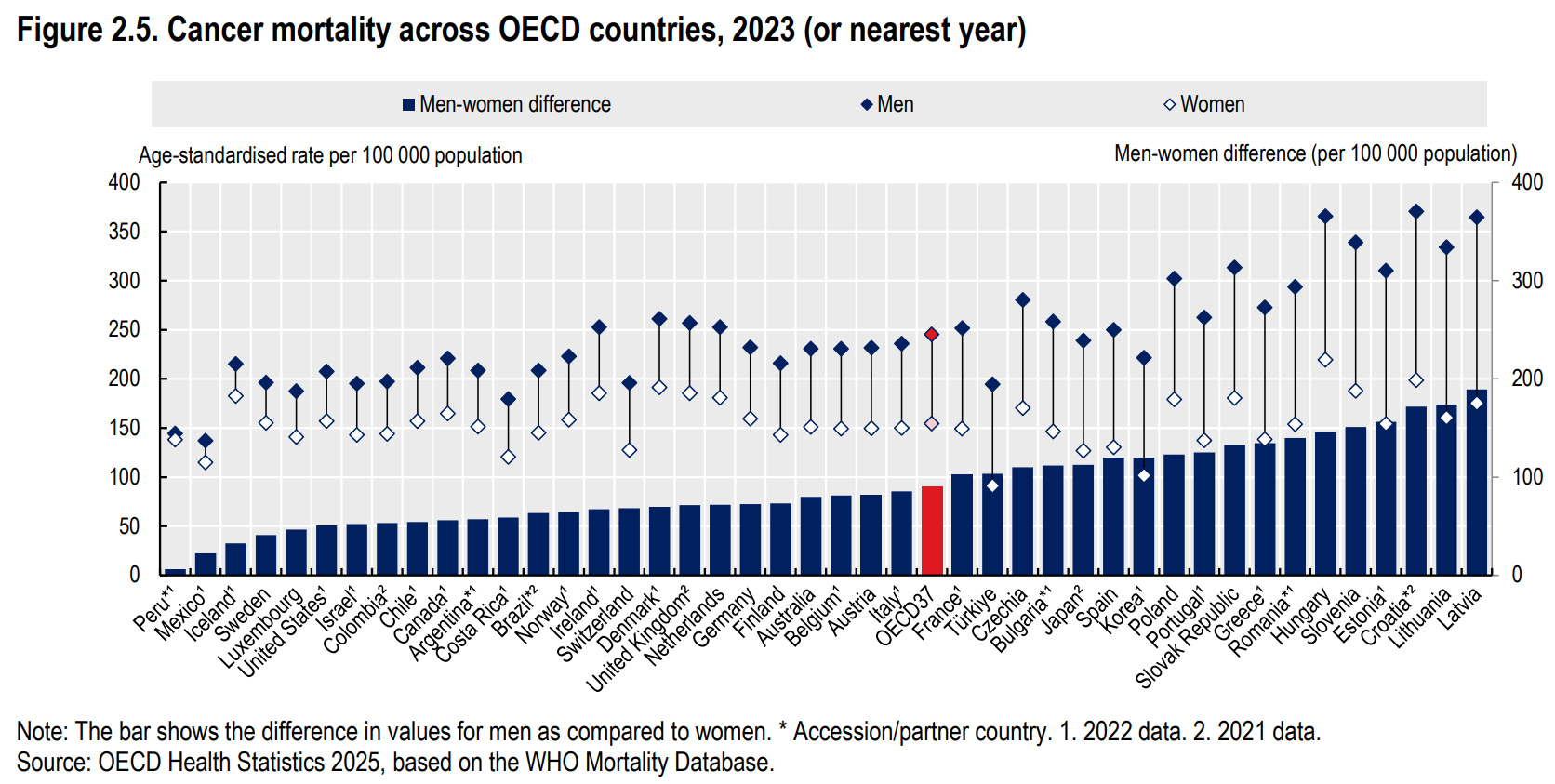
Figure 6: Figure 2.5 from OECD (2025). Age-standardized cancer mortality rates (per 100k population) for males and females, 2023, in several countries.
Figure 7 shows age-standardized mortality rates (per 100k population) for diseases of the circulatory system, for males and females, 2023, in several countries (OECD, 2025, their Figure 2.4). The higher mortality rate assigned to diseases of the circulatory system for males is a systematic and general feature.
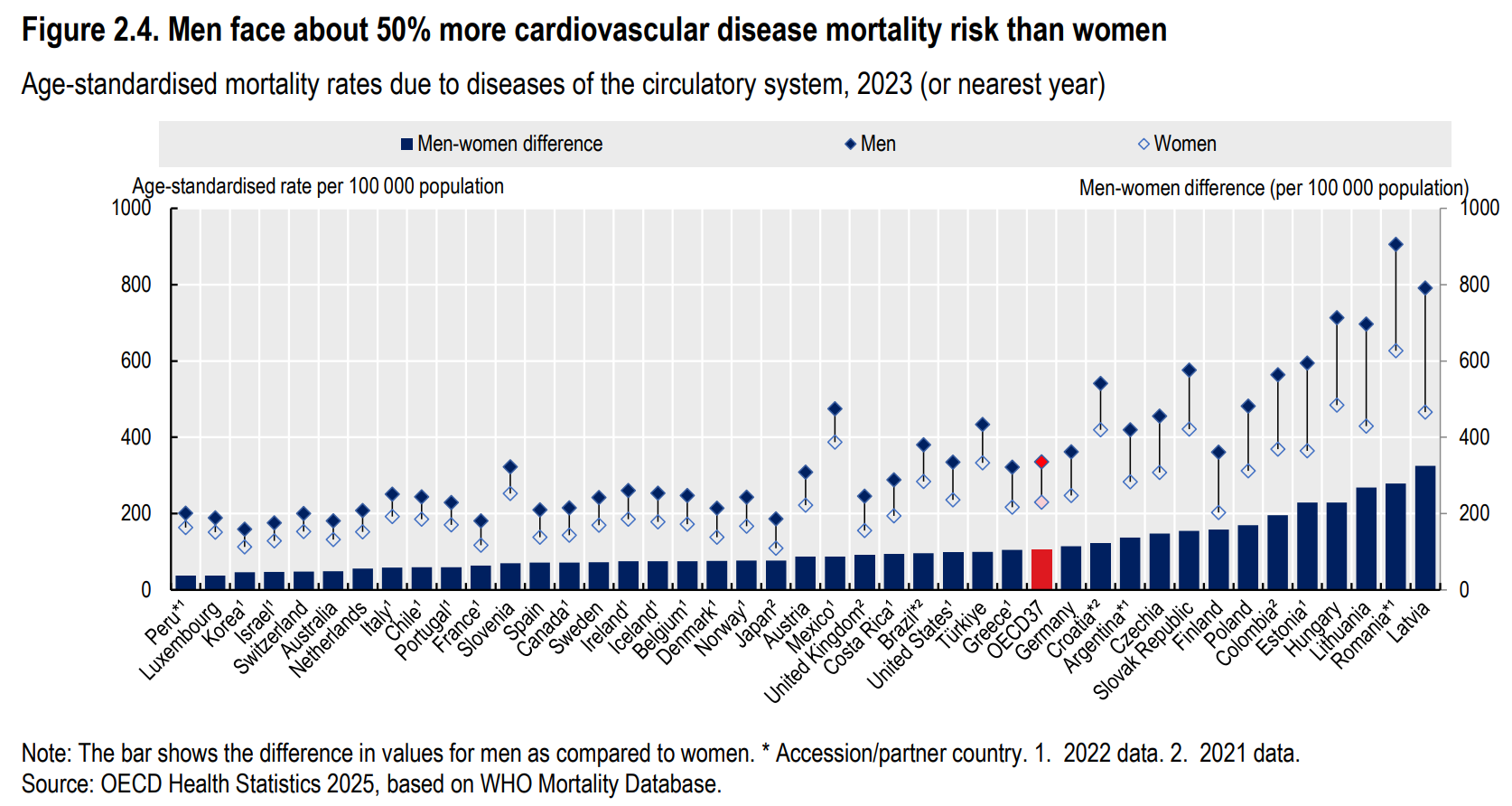
Figure 7: Figure 2.4 from OECD (2025). Age-standardized mortality rates (per 100k population) for diseases of the circulatory system, for males and females, 2023, in several countries.
Figure 8 shows age-standardized mortality rates (per 100k population) for intentional self-harm, for males and females, 2023, in several countries (OECD, 2025, their Figure 2.8). The self-harm mortality rates for males are systematically higher than for females, as a general feature in world societies.
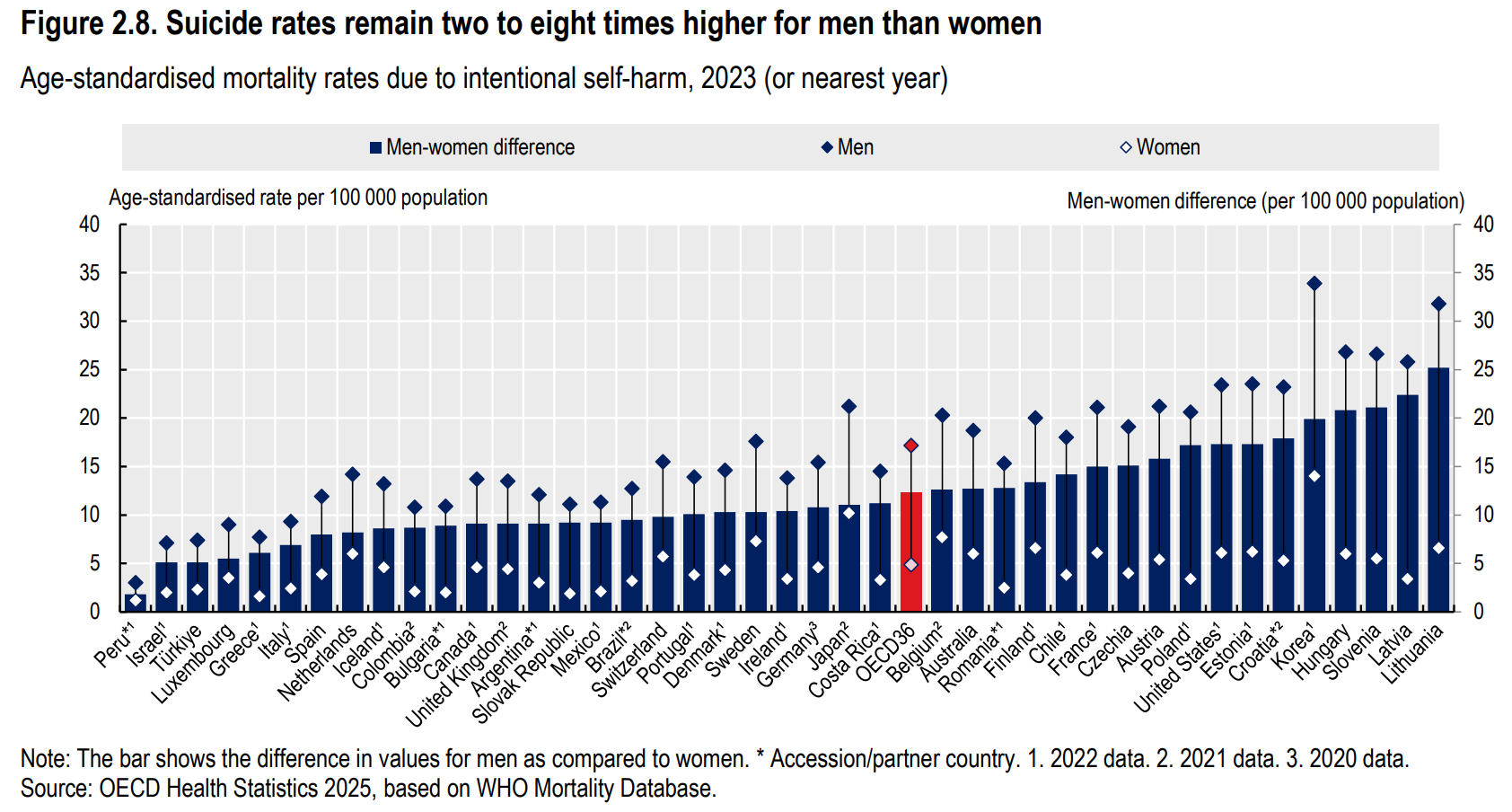
Figure 8: Figure 2.8 from OECD (2025). Age-standardized mortality rates (per 100k population) for intentional self-harm, for males and females, 2023, in several countries.
The systematic, robust and undeniable M > F sex difference in all-cause mortality rates (Figure 5) and in major-causes mortality rates (Figure 6, Figure 7), and in deaths from intentional self-harm (Figure 8), begs for a unified mechanistic explanation.
There are two main schools of thought on the biological mechanism for the said M > F sex difference, which are most often advanced and developed independently of each other and without much overlap. (There are also unconvincing secondary comments about “cultural determinants” and M/F health‑risk behavioural differences such as smoking.)
The said two schools of thought to explain the M > F mortality sex difference are:
- The M > F mortality sex difference is due to male and female differences in their immune systems and immune-system responses, including modulation by sex hormones (e.g., Klein and Flanagan, 2016).
- The M > F mortality sex difference is due to male and female differences in stress-response physiology and biochemistry, including modulation by sex hormones (e.g., Herman et al., 2016; James et al., 2023; Kudielka and Kirschbaum, 2005).
In my view, although sex hormones play an important role in both proposals, the first of these (I, immune system) is contrived and mistaken. It does not explain all the relevant observations taken together and it is not demonstrated in animal models. For example, cardiovascular diseases (Figure 7) have an established link to experienced stress, and it would be difficult to assign the robust sex difference in suicides (Figure 8) to the immune system.
On the other hand, the second (II, stress-response sexual dimorphism) consistently explains all the observations and has overarching predictive value. It originates in the foundational experimental work of Selye (1936, 1956, 1976a, 1976b) regarding stress response directed by the hypothalamic-pituitary-adrenal (HPA) axis.
The dominant and overarching importance of physiological and psychological stress in determining morbidity and mortality is recognized for non-human animal societies (Sapolsky, 2005), based among other things on field measurements of concentrations of the primary stress hormone cortisol; however, the central importance of stress is largely and erroneously overlooked in morbidity and mortality for the human animal (Cohen et al., 2007), including regarding respiratory diseases (Rancourt, 2024).
In my view, that the mortality sex difference holds for different major causes of death is strong evidence that it is due to the HPA-axis stress mechanism rather than the immune system. Furthermore, the individual’s status in the societal dominance hierarchy of any social animal is the dominant determinant of the individual’s morbidity and mortality, primarily because of stressful dominance assaults and oppression (Sapolsky, 2005). This implies a leading role of stress in the health of the individual animal. Here, “stress” perceived and experienced by the individual animal is many different things that can activate different stressor-specific pathways within the HPA-axis system (e.g., Dickerson and Kemeny, 2004).
Beyond studies of cortisol response and non-fatal HPA-axis deregulation and recovery, the important consequence regarding morbidity and mortality is that under sustained and impactful stress conditions the HPA response, which by design co‑opts main bodily functions (Chu et al., 2024), can become irreversibly activated, leading to death, one way or another (Mariotti, 2015; Selye, 1956; Yaribeygi et al., 2017). If the said HPA response is sex differentiated, then disease and mortality exhibit a sex difference.
HPA response is much stronger in males, while being somewhat downgraded by high testosterone levels (dominant males are more resilient against stress).
Beyond risk-seeking behaviours, stress-avoiding strategies, which will be stronger in males, include the fast-acting (and addictive) stress-alleviating substances: drugs, alcohol, smoking, etc., which in turn carry high risks of unintentional death. The result is seen in Figure 9, which shows age-standardized mortality rates (per 100k population) for avoidable causes, for males and females, 2023, in several countries (OECD, 2025, their Figure 3.4).
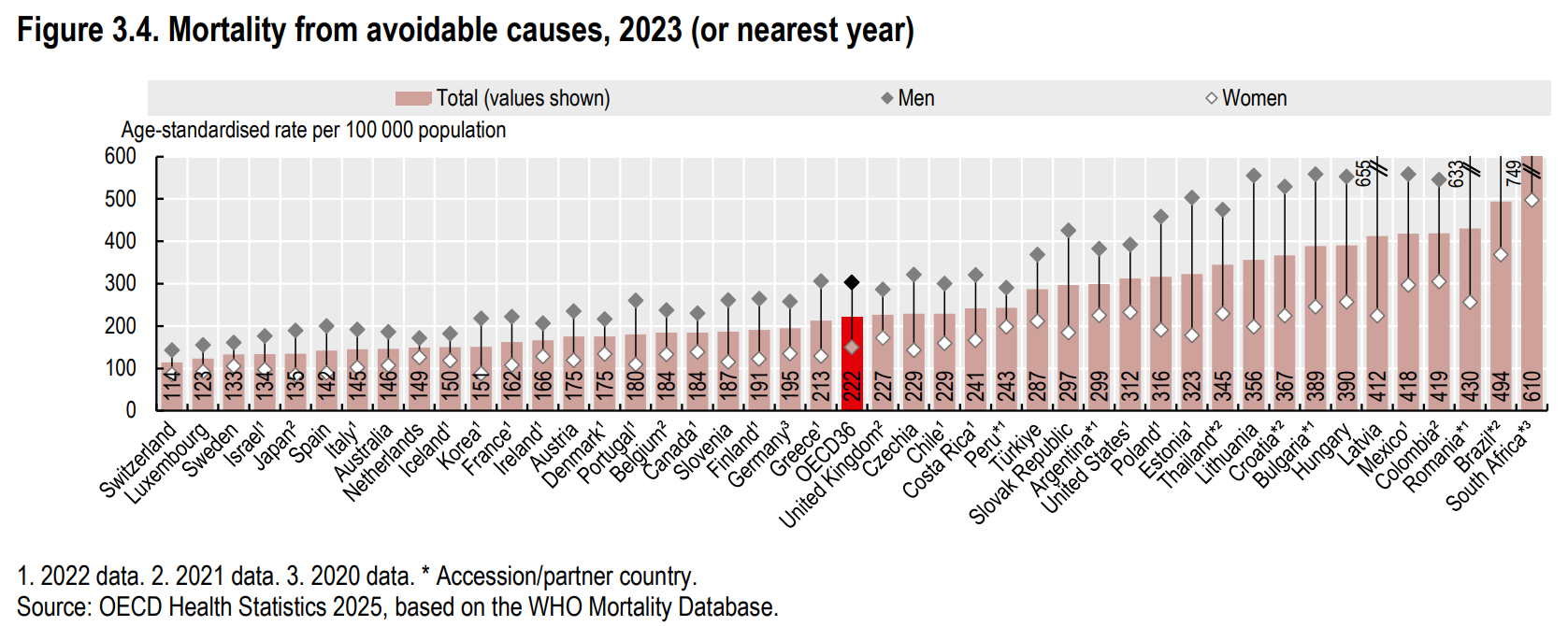
Figure 9: Figure 3.4 from OECD (2025). Age-standardized mortality rates (per 100k population) for avoidable causes, for males and females, 2023, in several countries.
* * *
Therefore, in light of the observations described in the Fact sections above, I conclude that essentially all the excess mortality of the Covid period, for both old and young, is due, directly or indirectly, to the specific and societal stress conditions that were integral to government so-called responses and public health campaigns. This includes the mortality assigned as COVID-19 (Fact #8; Rancourt, 2024).
Vaccine toxicity itself is real and unacceptable (Fact #5) but it made relatively little contribution to the massive (Fact #1) measured excess all-cause mortality. The rapid vaccine rollouts were high-stress disruptive events that caused excess mortality, as were rapid testing rollouts (Fact #4), but the toxicity itself was relatively less fatal.
Recently, Rancourt (2024) put it this way:
… the impugned COVID-19 vaccine rollouts may be synchronously accompanied by concomitant aggressive medical and/or health interventions, and the latter interventions would be the relevant primary cause(s) of death.
Examples of such accompanying interventions might include:
- the use of incorrectly stored or handled COVID-19 vaccination products
- incorrect combinations of COVID-19 vaccination products from different manufacturers
- incorrect physical administrations of the COVID-19 vaccine, using rushed or ill-trained staff
- testing for COVID-19, and the associated consequences of positive test results
- more aggressive or extreme immobilization, confinement and isolation enforcement during the vaccine rollout
- the psychological stress of being coerced into re-vaccination, in the institutional environment
- administration of influenza or other vaccinations
- administration of medications intended to facilitate acceptance or to alleviate side effects of the injections
- disrupted patient care schedule, including regular medication, meals and hydration
- transmitted stress of the attendants, or infections from the attendants
- and so on
The thus associated or accompanying assaults can be different in their array and different in magnitude from one country to another, from one institution to another, and from one COVID-19 vaccine rollout to another (with multiple doses, such as boosters). For example, Rancourt (2022) discusses the case of India, compared to the consequences of so-called vaccine-equity campaigns in the USA.
Basically, these types of actions, like any campaign of coordinated and largescale aggressive ...
• mandates,
• measures,
• so-called responses, and
• medical assaults including testing, diagnostic bias, imposed facial masking, confinement, isolation, denial of treatment (especially antibiotics for pneumonia), mechanical ventilation, sedation, experimental and improper treatments, and any coerced vaccination
... will increase physiological and psychological stress and thereby, among other pathways to death, induce fatal self-infection transmissionless bacterial pneumonias in elderly and ailing people (Rancourt, 2024). Social isolation and in‑bed immobilization are devastating for the sick and elderly, not to mention deprivation of touch and restriction of breathing.
Even adopting standard epidemiological models of viral spread (which are disproved, Fact #2), some of the most severe measures, such as segregating frail or unvaccinated people from the rest of the population are predicted to be deleterious or ineffective (Hickey and Rancourt, 2023a, 2023b).
Figure 10 shows a graphical representation of the conclusion that “stress caused everything” (Rancourt, 2025b, at p. 110).
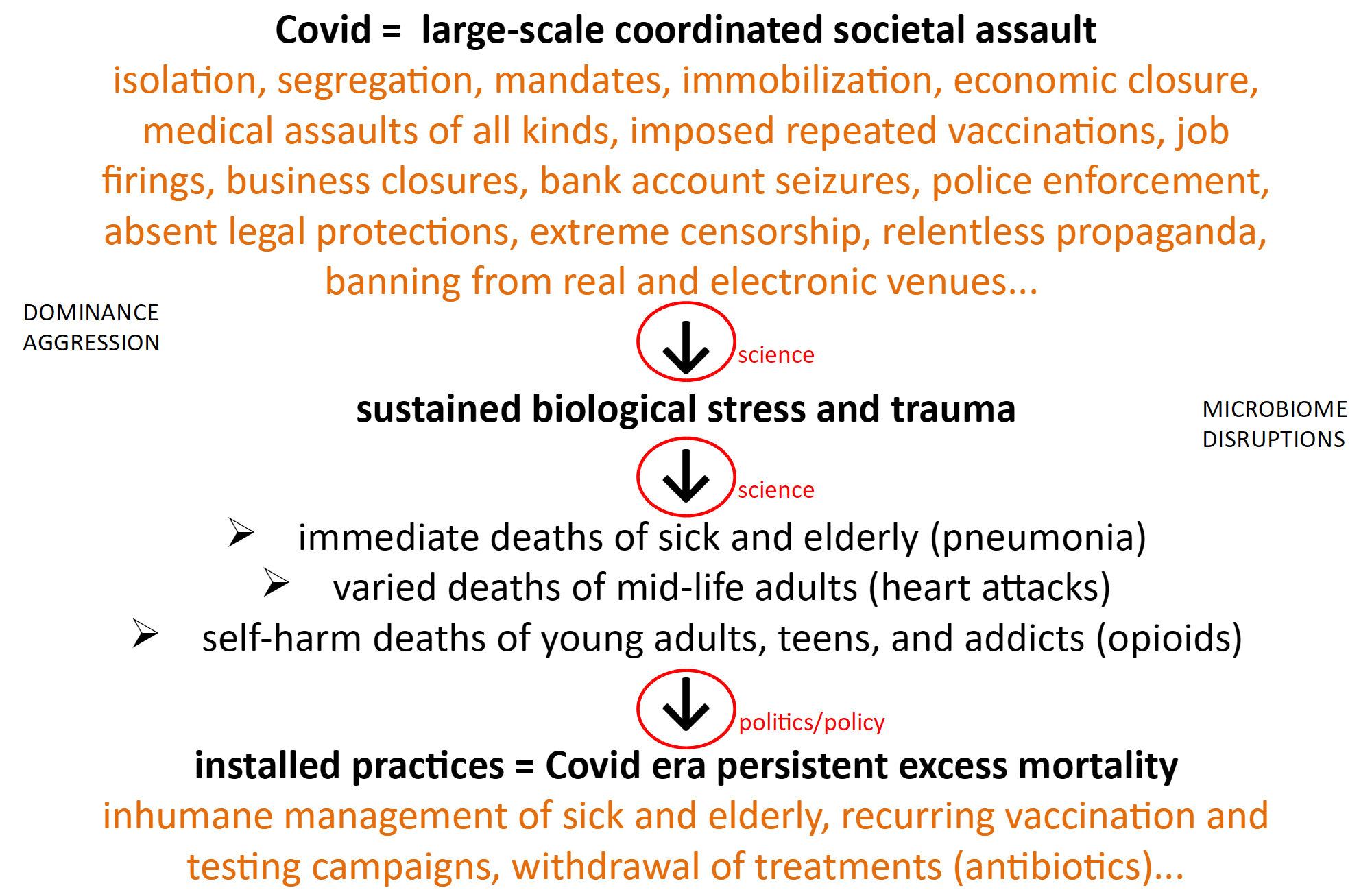
Figure 10: Graphical model of the cause of excess mortality during the Covid period, and institutional consequences. (Source: Rancourt, 2025b, at p. 110.)
A main lesson from the Covid period assault by governments should be that stress is overwhelmingly a (the) major cause of disease and early death in present societies; and that any similar violent government campaign will cause large excess morbidity and mortality.
The current medical establishment is misguided at best if focus on physiological and psychological (biological) stress is not the starting point. The HPA axis must be given a central interpretive role, in the dominance hierarchy that is society. In addition, the medical enterprise should stop doing harm (James, 2013; Makary and Daniel, 2016; Panagioti et al., 2019).
Conclusion
The spatial (jurisdictional), temporal, sex and age dependences of excess mortality during the Covid period (2020-2025) imply the following.
- Essentially all the excess mortality, including mortality assigned as COVID-19 mortality, was fundamentally caused by the Covid-period government and medical assaults that produced both fatal stress-response-induced microbiome-conditioned physiological system failures and fatal high-risk stress-relief strategies (drugs and alcohol) (Figure 10).
- No significant role can be assigned to a spreading new respiratory pathogen.
- Positive vaccine effectiveness (VE) values derived from clinical trials and calculated from observational studies are false.
- The COVID-19 vaccine harmed and killed many people (Fact #5) but not in a magnitude large enough to be evident in available population-level vaccination-status-discerned observational mortality studies (Fact #7).
Acknowledgement
I thank all my collaborators who accompanied me in and did the research: Drs. Marine Baudin, Joseph Hickey, John Johnson, Christian Linard and Jérémie Mercier. Most of our published reports are at: https://correlation-canada.org/
The Best “Go Paid” Deal on Substack! You Get REAL Stuff!!

Go paid at the $5 a month level, and we will send you both the PDF and e-Pub versions of Etienne’s new book: To See the Cage Is to Leave It - 25 Techniques the Few Use to Control the Many and a coupon code for 10% off anything in the https://artofliberty.org/store/.
Go paid at the $50 a year level, and we will send you a free paperback edition of Etienne’s new book: To See the Cage Is to Leave It - 25 Techniques the Few Use to Control the Many OR “Government” - The Biggest Scam in History… Exposed! OR a 64GB Liberator flash drive if you live in the US. If you are international, we will give you a $10 credit towards shipping if you agree to pay the remainder.
Support us at the $250 Founding Member Level and get a signed high-resolution hardcover of “Government” - The Biggest Scam in History... Exposed! + Liberator flash drive + a signed high-resolution hardcover of Etienne’s new book: To See the Cage Is to Leave It - 25 Techniques the Few Use to Control the Many + everything else in our “Everything Bundle” of the best in voluntaryist thought delivered domestically. International pays shipping. Our only option for signed copies besides catching Etienne @ an event.


Comments ()