
How Musk is using Starlink to reshape the world
The SpaceX owner’s satellite system has kept Iranians online and boosted Ukraine’s war effort, but his unpredictability is cause for concern
Etienne Note: Starlink is obviously a US Military communications system being used to help favored regimes and US-sponsored opposition groups in targeted countries while being sold to the public to subsidize the cost and privatize the profits to defense industry insiders who knew and understood the plan beforehand.
The volatile, fast-moving US-Israeli attack on Iran has a very different character from the grinding war in Ukraine. From both conflicts, however, one development is increasingly clear: Starlink, Elon Musk’s satellite internet system, has become the most important strategic business on Earth.
And Musk, who owns approximately 40 per cent of Starlink’s parent company, SpaceX, and controls 80 per cent of the voting rights, holds a level of geopolitical influence unprecedented for a corporate figure.
“There is no real parallel [to Starlink],” says Alp Toker, director of NetBlocks, an independent global internet monitor. “There is probably no equivalent in modern history. You could argue people are equally dependent on AWS [Amazon Web Services, a cloud computing company] but it doesn’t have the same political aspect.”
After months of slow Russian advances, Volodymyr Zelensky, the Ukrainian president, announced on Sunday that Ukraine had regained 168 square miles and thwarted a planned Russian offensive. “The spring campaign, as it had been planned, drowned in this spring for the Russians; they were unable to advance,” Zelensky told reporters.
According to the Institute of Study for War (ISW), a think tank based in Washington, DC, one factor in Ukraine’s recent resilience could be battlefield communications.
On Feb 1, Musk turned off his Starlink satellite internet in Ukraine for everyone except operators approved by the Ukrainian government, depriving Russian units who had been using the system to communicate with each other and guide their drones. According to analysis by Kentik, a network infrastructure firm, Starlink traffic in Ukraine fell by 75 per cent after the switch-off, implying that three out of every four terminals had been in Russian hands
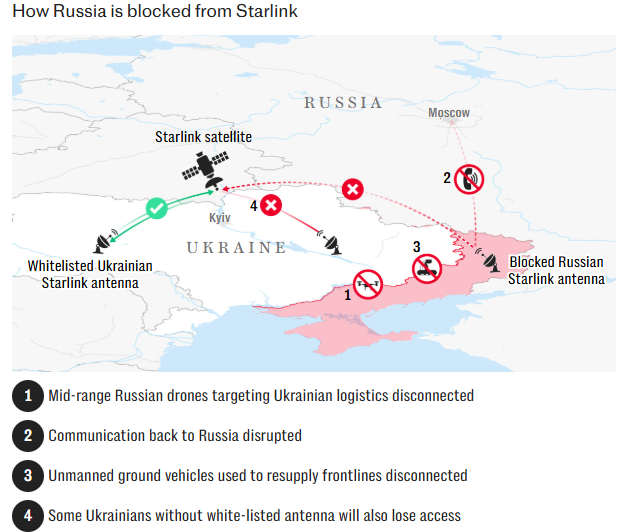
“Starlink has become critical for both sides in this war, and the February 1 blocking of Russia’s terminals has had critical battlefield effects in recent weeks,” says Christina Harward, Russia deputy team lead at the ISW. “Russia’s inability to use their Starlink terminals has also degraded their situational awareness and complicated their command and control. Ukraine has been able to exploit these Russian vulnerabilities on the battlefield. Ukrainian counterattacks there have been quite successful recently, with Ukraine liberating more territory than it has lost some weeks.”There have also been reports that the Kremlin has banned forces from using Telegram, the messaging system, for fears it has been compromised. According to one Russian military blogger, “the blocking of Telegram will likely degrade Russian command and control and exacerbate existing issues with communication that Russian forces have struggled with since the February 1 Starlink block”.
Starlink began in 2015 as a subsidiary of SpaceX, Musk’s private rocket company, which was already launching satellites for government customers. The aim was simple: provide fast, relatively cheap internet access in hard-to-reach places. The first 60 satellites were launched in 2019.
“We think this is a key stepping stone on the way towards establishing a self-sustaining city on Mars and a base on the moon,” Musk said at the time. The system has since become a lifeline for remote populations, from research bases to the remote Pitcairn island.
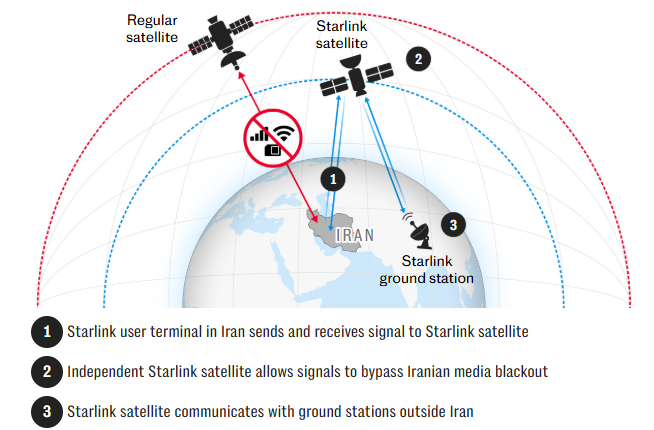
In Iran, meanwhile, Starlink has been a vital tool for bypassing government restrictions. In the weeks leading up to the current US-Israeli military action, the Iranian regime brutally cracked down on protesters, killing thousands. In early January, it shut down the internet. Starlink receivers, however, are as small as a sheet of A3 paper, connect to thousands of satellites in low Earth orbit and can bypass conventional infrastructure.

While governments can shut down the traditional networks which rely on cables, towers and other nationally owned apparatus, Starlink users’ direct connection to overhead satellites is much harder to control.
Starlink is banned in Iran, both by the government and by US sanctions, but smugglers have found ways to bring the devices across the border. As many as 30,000 terminals are thought to be in the country, up from just 200 four years ago.
“[Starlink smuggling] started in 2022 when Elon Musk and the State Department made it so that Starlink could work inside Iran,” says one person involved with smuggling Starlinks into Iran. “Because of sanctions, smuggling has always been part of Iranian life. After the 12-day war broke out last June, Starlink dishes were specifically outlawed inside of Iran, with heavy penalties, and cars going in and out of cities were being searched. The government asked folks to snitch on each other, to report any sightings of dishes.
“Iran’s access to the [regular] internet goes through a single choke point, so it can in effect be turned off for the whole country with the flick of a switch,” they add. “To get around this, you need to find alternative communication methods. A VPN [virtual private network], for example, would still try to find some kind of hole or gap inside the firewall that locks all of these connections. Starlink doesn’t require you to cross that firewall at all. It’s an alternative system entirely.”
How Starlink bypasses Iran’s internet blackouts
As the Iranian regime cracked down this year, protesters used Starlink to broadcast news to the outside world. In February, Russian and Iranian officials complained to the UN about Starlink, with Tehran saying the “illegal operation” of the system violated national sovereignty and amounted to “unauthorised military use of a commercial satellite mega-constellation”.
Fereidoon Bashar, executive director of ASL19, a digital rights organisation focused on Iran, says demand has pushed prices of Starlink receivers sharply higher.
“They’ve gone up now to around $3,500 [£2,620] each; they were around $2,000 just a month ago”, he says. “More and more people are planning and preparing for when the internet will be shut down again and Starlink proved to be one of the most effective tools.”
It is not only protesters who have found Starlink useful. This week, an Iranian hacker group called Handala used another Musk platform, X, to announce a retaliatory “cyber operation” against US and Israeli attacks. It reportedly used Starlink to do so. The account was shut down soon afterwards, but the episode showed the dilemma facing Musk, an outspoken free-speech advocate who now wields enormous influence.
The routes used to smuggle Starlink into Iran
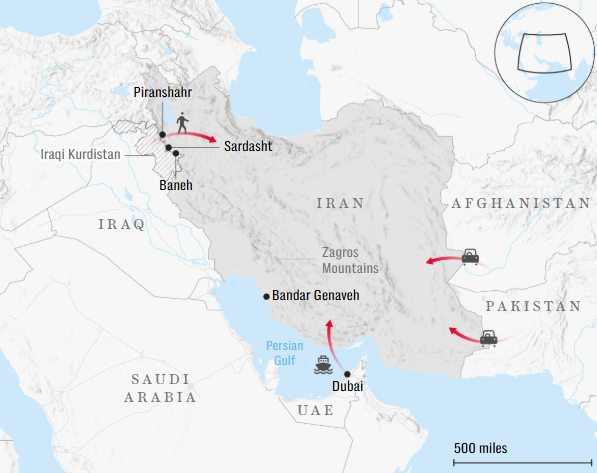
“Starlink’s success boils down to one thing: thanks to its consumer user base, it has a critical mass which military networks have never really achieved,” says Toker. “So it offers high-strength global coverage, and it blends into global traffic so [signals] don’t stand out. It is also relatively low-cost. And even though SpaceX is a private company, it is still within the purview of US policy. It works out well for everyone.”
Starlink is increasingly appearing on the battlefield itself. In Iran, the US has used its new Low-Cost Uncrewed Combat Attack System, or Lucas, for the first time. This “kamikaze” drone resembles the Iranian Shahed drones that have caused such destruction in Ukraine. Some are equipped with Starlink receivers.
Experts say Starlink’s design makes it particularly useful in war.
“Starlink provides two main things in a military context,” says Dr Thomas Withington, a fellow of the Royal United Services Institute (RUSI), a defence think tank. “Firstly, it provides battlefield trunk communications. We can use cell phones in daily life because of the infrastructure around us. When a military deploys, it has to take all its communications with it. Not just radios, but the network that enables those to work. Military radios can generally only communicate as far as the eye can see, about five or 10 kilometres, so Starlink becomes very attractive to use for long-distance military communications.
“The other thing Starlink is used for is drones. If you want a drone to travel long distances, you need a way of sending commands to it and receiving information back. Compared to other systems, Starlink has a couple of tricks that make it unique. First, it can carry large amounts of data, so you can send videos, which is useful for a commander. Second, it’s hard to jam, because the signal is incredibly narrow.”
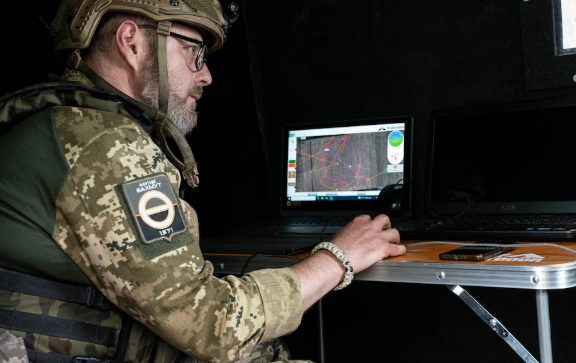
Harward, of the ISW, says the Starlink shutdown has had a decisive effect on Russia’s drone capabilities in Ukraine. “One area where Russia has suffered since the [Starlink] shut down is their mid-range strike campaign,” she says. “Russian forces were putting Starlinks on their tactical and long-range drones at scale in early 2026. This helped to extend the range of Russian FPV drones so they could strike Ukrainian supply lines, threatening areas in the rear that were previously not under threat.”
But Starlink has been politically charged long before its recent shutdown. Musk activated the service at the start of Russia’s full-scale invasion of Ukraine in February 2022 in response to requests from Zelensky’s government. Later that year, Musk said he had spent $80m (£60m) “out of pocket” providing it. In September 2022, in response to a request from Anthony Blinken, the US secretary of state, Musk activated Starlink in Iran.
A 2023 biography of Musk by Walter Isaacson also alleged that he had turned off the service during a Ukrainian operation near Sevastopol. “There was an emergency request from government authorities to activate Starlink all the way to Sevastopol,” Musk said on X in response. “The obvious intent being to sink most of the Russian fleet at anchor… If I had agreed to their request, then SpaceX would be explicitly complicit in a major act of war and conflict escalation.”
Musk’s latest action, restricting terminals so only those on a Ukrainian government “white list” could operate, marks a firmer line than he has taken before. Speaking to the BBC, one Ukrainian drone operator estimated the move reduced Russian offensive capacity by 50 per cent.
“There have been mixed signals over Ukraine,” says RUSI’s Withington. “Initially SpaceX were supportive of getting terminals into Ukraine. It really made a difference. Then they started to blow hot and cold over things, saying ‘this is being used for military purposes’. But this recent thing, of working with Ukraine to register terminals with the government, has created some real problems for Russia.”
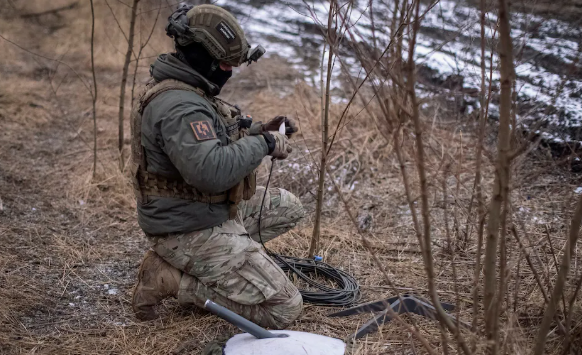
Despite the controversy over Sevastopol, Musk has rarely used Starlink in ways that diverge far from US policy. SpaceX relies heavily on government contracts. But Musk is also an unpredictable political figure who played a prominent role in Donald Trump’s second election.
“Starlink is changing lives,” says Toker. “It is making a difference. But [politics] is probably going to become a problem down the line. As long as it stays in the hands of SpaceX and Elon Musk, the risk of a blowout is going to be there. One of these political debates is probably going to boil over. But for now, it’s still the good times.”
The concentration of so much power in one company raises questions about state capacity and vulnerability.
“It becomes a Clausewitzian centre of gravity, where if you don’t have [Starlink] on the battlefield it’s really bad news,” says Withington, referring to the Prussian military theorist’s concept of hubs on which a battle depends.
The US military uses Starshield, a secure military and government arm of Starlink. Other countries are moving to minimise their dependency on Musk’s service. Some are considering building their own systems, though it is doubtful whether they can match Musk’s scale.
“The UK Government does not have a shining track record when it comes to building big infrastructure,” says Toker. “Maybe it is better to outsource it.”
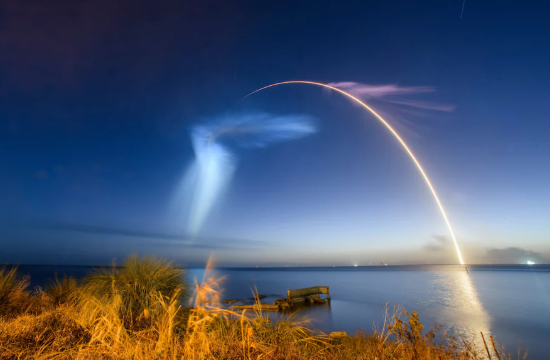
The private sector is responding too. Earlier this year, Blue Origin, the space company owned by Amazon founder Jeff Bezos, announced a rival satellite network with 5,400 satellites in low orbit. Meanwhile, recent disputes between the US government and AI companies, such as Anthropic and OpenAI, concerning military use show that the relationship between Silicon Valley and the Pentagon is far from simple.
In the short term, increasingly desperate Russian forces are having to jury-rig solutions to the Musk-imposed shutdown, says Harward. “Russia is already trying to find an alternative to Starlink, experimenting with things like stratospheric balloons with 5G connectivity,” she says. “But even Russian sources doubt that such systems will be able to fully replace Starlink’s complex communications network. Russian forces have in the meantime been resorting to less than ideal solutions, like placing antennas high on top of roofs in frontline villages. Ukraine has only increased its strikes against these antennas in response and are even using the antennas to find Russian drone operators themselves, to strike right at the source.”
For now, Starlink remains the only satellite network operating at scale on modern battlefields. And its mercurial boss has the power to shape not just who has access to rural broadband, but the fate of nations.
“Government” – The Biggest Scam in History… Exposed! is now Shipping! Get a Copy for “Going Paid”

“Government” – The Biggest Scam in History… Exposed! Version 5.5 Now Shipping! Get Details Here:
Get a copy for “Going Paid” OR… Even better… Becoming a Sponsor at ArtOfLiberty.org/Sponsor.. Get Perks!
Go paid at the $5 a month level, and we will send you both the PDF and e-Pub versions of Etienne’s NEW 5.5 version of: “Government” - The Biggest Scam in History… Exposed! 5.5 Edition and a coupon code for 10% off anything in the https://artofliberty.org/store/.
Go paid at the $50 a year level, and we will send you a free paperback edition of Etienne’s new 5.5 version of: “Government” - The Biggest Scam in History… Exposed! OR To See the Cage Is to Leave It - 25 Techniques the Few Use to Control the Many OR a 64GB Liberator flash drive if you live in the US. If you are international, we will give you a $10 credit towards shipping if you agree to pay the remainder.
Support us at the $250 Founding Member Level and get a signed high-resolution hardcover of “Government” - The Biggest Scam in History... Exposed! 5.5 edition + Liberator flash drive + a signed high-resolution hardcover of Etienne’s new book: To See the Cage Is to Leave It - 25 Techniques the Few Use to Control the Many + everything else in our “Everything Bundle” of the best in voluntaryist thought delivered domestically. International pays shipping. Our only option for signed copies besides catching Etienne @ an event.

“Go Paid” at any level OR Sponsor at ArtOfLiberty.org/Sponsor and get a FREE virtual ticket to An Evening with Etienne de la Boetie2
Live in Memphis and streamed globally on Thursday, March 26th


Comments ()