
Key U.S. yield at 5% highlights mounting pressure in bond market
At the heart of the selloff is a fresh bout of concern over inflation and the possibility of fewer interest-rate cuts
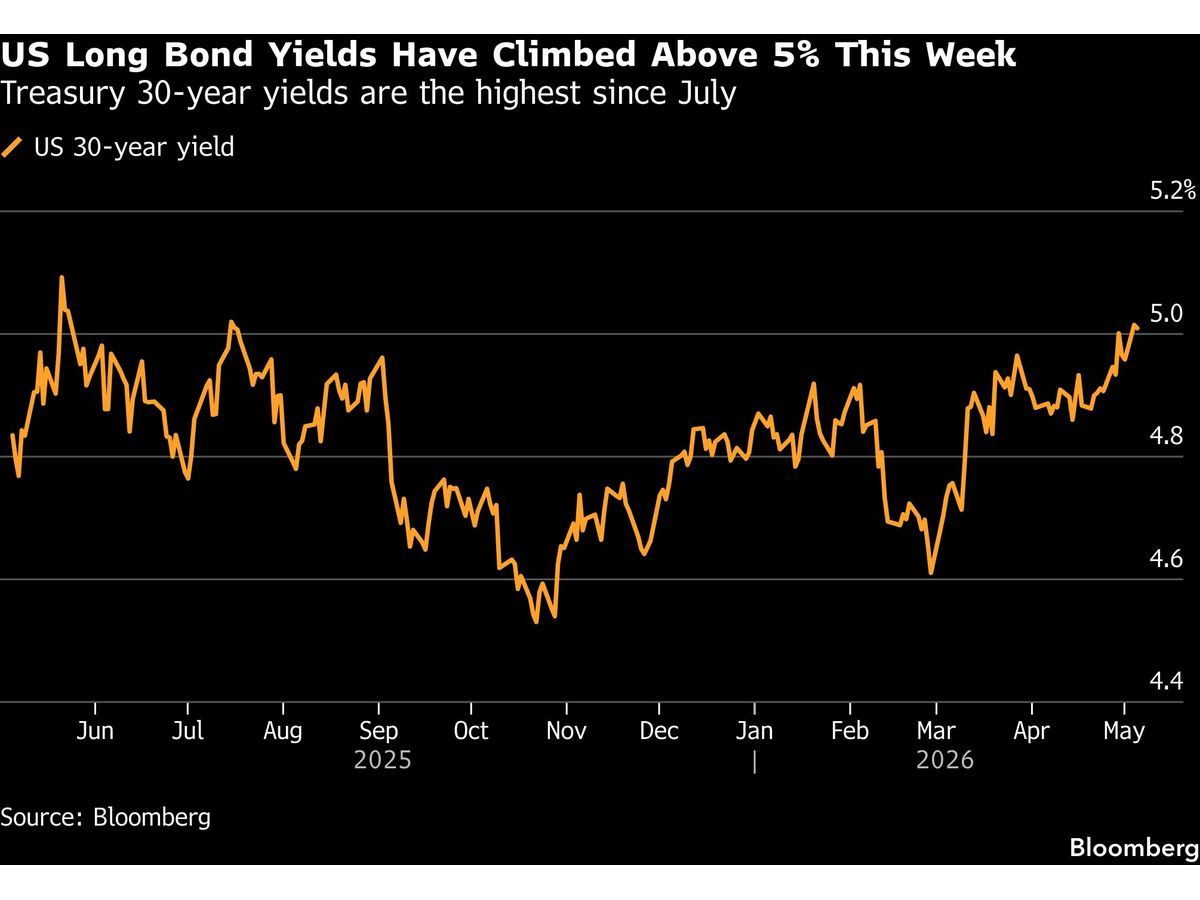
The yield on 30-year U.S. government debt hovered around five per cent after breaching the key level for the first time since July at the start of the week — suggesting pressure in the world’s biggest bond market isn’t letting up.
It’s a threshold that carries special importance, with some viewing it as a “line in the sand” and traders watching for signs it could shift higher. The yield was at 5.01 per cent as of 6:42 a.m. after hitting 5.03 per cent on Monday.
At the heart of the selloff is a fresh bout of concern over inflation and the possibility of fewer interest-rate cuts as oil prices soar with the Strait of Hormuz still shuttered. A torrent of company spending on artificial intelligence is also raising fears price growth could accelerate in the short term.
A yield of five per cent or beyond is important because it makes fears about the budget and the growing debt-servicing costs for the U.S. government more urgent. It also has significant implications for other financial markets and the real economy, potentially raising mortgage rates and hurting consumers.
“We’ve seen bonds reprice because the expectation of rates staying higher for longer, or not having as many cuts, has changed, and I think that’s rational,” said Vivek Paul, Global Head of Portfolio Research and U.K. Chief Investment Strategist for the BlackRock Investment Institute, said in an interview on Bloomberg TV.
Economic data before the outbreak of war on Feb. 28 also suggested inflation globally was not slowing as quickly people had expected, while the U.S. economy remains in reasonable health, he added.
“All signs point to higher inflation than the market has been historically expecting,” Paul said.
Long-bond underweight
BlackRock Investment Institute has an underweight position on long U.S. Treasuries, with the energy shock and existing headwinds set to drive term premiums higher. That refers to the additional yield investors demand to hold a longer-term bond instead of rolling over a series of shorter-term notes in the same period.
The outlook is muddying the prospects for interest-rate cuts, something that was widely anticipated heading into 2026 with Kevin Warsh taking over at the helm of the Federal Reserve. Markets have flipped to pricing further tightening from the central bank and swaps imply a 50 per cent chance of a quarter point move in early 2027.
The Fed last week kept the key benchmark rates steady in a range between 3.5 per cent and 3.75 per cent. But three officials dissented over the policy statement, saying it was no longer appropriate to signal that the Fed’s next move was still likely to be an interest-rate cut.
Henrietta Pacquement, senior portfolio manager for fixed income at Allspring, said yields are reaching “interesting” levels for investors, but she prefers intermediate U.S. Treasuries.
“The long-end is an area where we’ve actually been quite cautious, as that’s where we are expecting volatility because of the duration,” she said.
Yields could break out above recent ranges on further disruption to energy supplies, for example if oil infrastructure in the Middle East sustains further damage, Pacquement added. More AI-fueled growth in the U.S. could also elicit a reaction from the central bank, potentially also pushing yields higher.
Bond plan
While monitoring the Middle East turmoil, bond traders are looking ahead to the U.S. government’s quarterly financing plan, due to be announced Wednesday. It typically provides guidance on the sizes of its note and bond auctions through July.
While the previous announcement in February reiterated the outlook for unchanged auction sizes “for at least the next several quarters,” investors and strategists expect the guidance to have changed because increases may be needed sooner.
“From a timing perspective, it is interesting that yields are pushing above the five per cent mark during a U.S. refunding week,” said Frederik Romedahl Poulsen, chief strategist at Velliv Pension & Livsforsikring AS.
While he expects the announcement to be “largely uneventful,” there is “certainly a risk that the US Treasury could begin subtly tweaking its forward guidance ahead of a likely change in auction sizes next year.”
With assistance from James Hirai and Georgia Hall
The Best “Go Paid” Deal on Substack! You Get REAL Stuff!!

Go paid at the $5 a month level, and we will send you both the PDF and e-Pub versions of Etienne’s new book: To See the Cage Is to Leave It - 25 Techniques the Few Use to Control the Many and a coupon code for 10% off anything in the https://artofliberty.org/store/.
Go paid at the $50 a year level, and we will send you a free paperback edition of Etienne’s new book: To See the Cage Is to Leave It - 25 Techniques the Few Use to Control the Many OR “Government” - The Biggest Scam in History… Exposed! OR a 64GB Liberator flash drive if you live in the US. If you are international, we will give you a $10 credit towards shipping if you agree to pay the remainder.
Support us at the $250 Founding Member Level and get a signed high-resolution hardcover of “Government” - The Biggest Scam in History... Exposed! + Liberator flash drive + a signed high-resolution hardcover of Etienne’s new book: To See the Cage Is to Leave It - 25 Techniques the Few Use to Control the Many + everything else in our “Everything Bundle” of the best in voluntaryist thought delivered domestically. International pays shipping. Our only option for signed copies besides catching Etienne @ an event.


Comments ()