
Lack of sleep ‘fuelling cancer surge in under 50s’
Insomniacs are up to three times more likely to develop some forms of disease
A lack of sleep could be fuelling a surge in cancer among the under-50s, according to the largest study of its kind.
Insomniacs are up to three times more likely to develop some forms of the disease than those without diagnosed sleep problems.
New research, presented at the 2026 American Society of Clinical Oncology annual meeting in Chicago, has suggested for the first time that sleep could be a contributing factor to the rate at which bowel and other cancers are increasing in younger people.
Sleep disorders are on the rise in the UK, coinciding with the advent of smartphones and other technology that emit “blue light”, which suppresses melatonin, the hormone responsible for the onset of sleep.
The problem is particularly affecting young adults and teenagers, with NHS data showing that two-thirds of those aged 17 to 23 struggle with sleep.
The increase in cancer cases has also been prevalent among the under-50s, including Dame Deborah James, who was known as “bowel babe” as she documented her battle with bowel cancer, and the Princess of Wales, who is in remission from an unspecified cancer
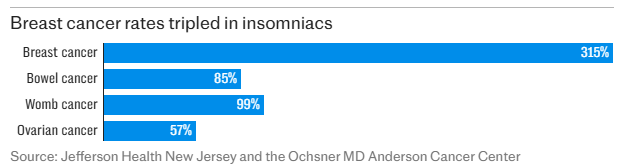
Researchers from Jefferson Health New Jersey and the Ochsner MD Anderson Cancer Center, both in the US, found that poor sleepers were more than three times as likely to be diagnosed with breast cancer within five years of an insomnia diagnosis.
They were about twice as likely to be diagnosed with bowel and womb cancers, and 57 per cent more likely to be diagnosed with ovarian cancer.
Apparent increases in rates of prostate and gastrointestinal cancers were not significant enough to be included, the researchers said.
In the study, researchers compared data from more than 413,000 people with insomnia aged 18-50 and 18.4 million people without sleep issues.
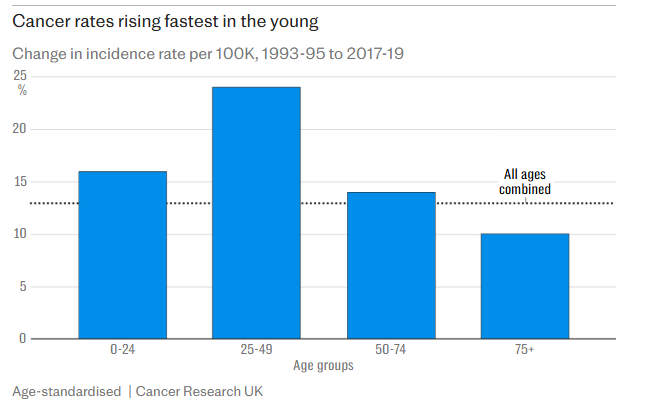
Recent analysis by experts at the Institute of Cancer Research in London and Imperial College London found that 11 cancers – including breast, bowel, liver, kidney, pancreatic and ovarian cancer – were becoming more common among younger adults
Claire Coughlan, the clinical lead at Bowel Cancer UK, said there was “a growing body of evidence globally that bowel cancer is increasing in younger people, including within the UK”.
A lack of sleep could be fuelling a surge in cancer among the under-50s, according to the largest study of its kind.
Insomniacs are up to three times more likely to develop some forms of the disease than those without diagnosed sleep problems.
New research, presented at the 2026 American Society of Clinical Oncology annual meeting in Chicago, has suggested for the first time that sleep could be a contributing factor to the rate at which bowel and other cancers are increasing in younger people.
Sleep disorders are on the rise in the UK, coinciding with the advent of smartphones and other technology that emit “blue light”, which suppresses melatonin, the hormone responsible for the onset of sleep.
Advertisement
The problem is particularly affecting young adults and teenagers, with NHS data showing that two-thirds of those aged 17 to 23 struggle with sleep.
The increase in cancer cases has also been prevalent among the under-50s, including Dame Deborah James, who was known as “bowel babe” as she documented her battle with bowel cancer, and the Princess of Wales, who is in remission from an unspecified cancer.
Researchers from Jefferson Health New Jersey and the Ochsner MD Anderson Cancer Center, both in the US, found that poor sleepers were more than three times as likely to be diagnosed with breast cancer within five years of an insomnia diagnosis.
They were about twice as likely to be diagnosed with bowel and womb cancers, and 57 per cent more likely to be diagnosed with ovarian cancer.
Apparent increases in rates of prostate and gastrointestinal cancers were not significant enough to be included, the researchers said.
In the study, researchers compared data from more than 413,000 people with insomnia aged 18-50 and 18.4 million people without sleep issues.
Recent analysis by experts at the Institute of Cancer Research in London and Imperial College London found that 11 cancers – including breast, bowel, liver, kidney, pancreatic and ovarian cancer – were becoming more common among younger adults.
Claire Coughlan, the clinical lead at Bowel Cancer UK, said there was “a growing body of evidence globally that bowel cancer is increasing in younger people, including within the UK”.
Advertisement
“We don’t know exactly why this is yet, but researchers currently believe it may be due to genetics, and lifestyle factors,” she said.
“This study’s conclusion that insomnia may be a potential risk factor in early-onset colorectal cancer could go some way to helping us understand the reasons behind this increase.”
Around one in three adults in the UK –16 million people – are thought to suffer from insomnia in the UK.
Dr David Garley, a GP and director of The Better Sleep Clinic, said there was strong evidence that insomnia drives health conditions such as diabetes, heart disease, and poor mental health.
He said: “When sleep deprived, it’s difficult to live a healthy life – there is more drinking, more obesity, less exercise, more smoking etc – and these may be what causes any possible increased risk.”
Dr Garley said sleep played a role in restoring the immune system and that “insomnia is often very closely linked to anxiety”, which could be made worse by the suggestion of cancer.
“There often is a lot of health anxiety among people with insomnia, and it might be that people are presenting earlier. It’s interesting early data but there are certainly no conclusions just yet.”
Simon Vincent, the chief scientific officer at Breast Cancer Now, said the research was “a starting point”, but more evidence was needed.
“It’s vital to note that an association does not prove that insomnia causes breast cancer,” he said.
“It’s very important to remember that breast cancer risk is influenced by many factors outside of our control, for example, your age, genes or how tall you are. However, small actions that everyone can take to reduce risk are staying physically active, limiting alcohol, being breast aware and attending screening appointments when invited.”
The Best “Go Paid” Deal on Substack! You Get REAL Stuff!!

Go paid at the $5 a month level, and we will send you both the PDF and e-Pub versions of Etienne’s new book: To See the Cage Is to Leave It - 25 Techniques the Few Use to Control the Many and a coupon code for 10% off anything in the https://artofliberty.org/store/.
Go paid at the $50 a year level, and we will send you a free paperback edition of Etienne’s new book: To See the Cage Is to Leave It - 25 Techniques the Few Use to Control the Many OR “Government” - The Biggest Scam in History… Exposed! OR a 64GB Liberator flash drive if you live in the US. If you are international, we will give you a $10 credit towards shipping if you agree to pay the remainder.
Support us at the $250 Founding Member Level and get a signed high-resolution hardcover of “Government” - The Biggest Scam in History... Exposed! + Liberator flash drive + a signed high-resolution hardcover of Etienne’s new book: To See the Cage Is to Leave It - 25 Techniques the Few Use to Control the Many + everything else in our “Everything Bundle” of the best in voluntaryist thought delivered domestically. International pays shipping. Our only option for signed copies besides catching Etienne @ an event.


Comments ()