
Trump Accused of Insider Trading After Making 3,642 Stock Trades in Companies He Promoted
Trump’s personal financial activity from January through March 2026 shows about 3,700 individual stock transactions were made – more than 40 trades per market day .
Etienne Note: This article also appears in “Government”, Media and Academia Criminality Exposed, A digest of HUNDREDS and HUNDREDS of articles exposing and suggesting inter-generational organized crime’s control of the “Government,” Media and Academia by the Art of Liberty Foundation. You can view the other articles or subscribe on Telegram: https://t.me/Government_Scams
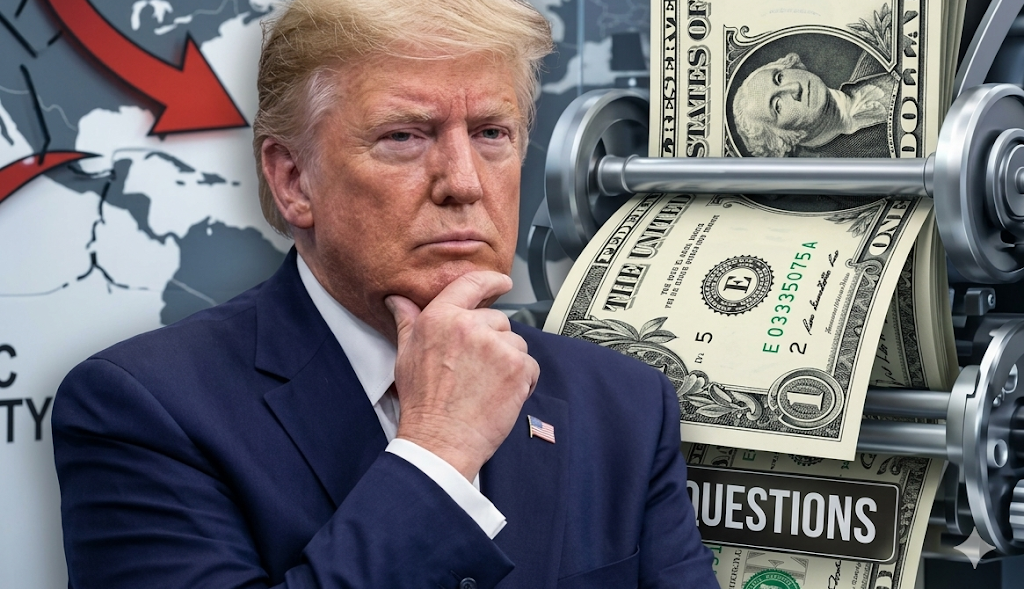
by AOL, AP, DropSite News and 60 Minutes
Trump’s personal financial activity from January through March 2026 shows about 3,700 individual stock transactions were made – more than 40 trades per market day .
The cumulative value of the trades is listed in broad ranges, as required by federal ethics rules, rather than exact figures. At the low end, total transactions exceed $220 million, and the ceiling approaches $750 million.
Trump’s account was buying stocks in companies whose fortunes are directly shaped by his own administration’s policy decisions. For example, Trump purchased millions of dollars of Oracle stock in early 2026, around the same time his administration was helping the company secure a deal to continue operating TikTok in the US.
Trump is the first sitting president to trigger the STOCK Act disclosure requirement, because he’s the first to actively trade individual stocks while still in office.
From 2025:
From AOL:
Trump made $220M in stock trades in companies he later promoted. Jim Cramer was speechless. Social media isn’t — they’re calling it insider trading
Jim Cramer has an opinion on nearly everything. But on Monday, for the first time in recent memory, he didn’t. On CNBC’s Squawk on the Street (1), co-host Carl Quintanilla noted President Donald Trump had been personally trading Intel stock in the first quarter — the same company the U.S. government took a 10% stake in last August. Cramer started to say the government might sell Intel shares to benefit Americans, but suddenly stopped talking, and said nothing coherent for 10 seconds straight.
Co-host David Faber then filled the air: “Got nothing to say?” And with Cramer still stuttering, Faber told the audience “We’re not having technical difficulties here, everybody but we gotta go.”
Cramer never really answered.
Join the Coalition! Become an affiliate member today! Click Here!
What ethics filings actually show
Last week, the U.S. Office of Government Ethics (OGE) published (2)two Form 278-T (2) disclosure reports covering Trump’s personal financial activity from January through March 2026. The documents, more than 100 pages, show more than 3,700 individual stock transactions (3). That’s more than 40 trades per market day across a three-month period.
The cumulative value of the trades is listed in broad ranges, as required by federal ethics rules, rather than exact figures. At the low end, the total exceeds $220 million. The ceiling approaches $750 million. The filings don’t specify who directed the trades, and they don’t disclose exact prices, timing within the trading day or profit-and-loss figures. The president’s assets are held in a trust managed by his children, and some transactions indicate a broker acted as an agent.
The White House said Trump’s assets are held in a trust managed by his children. “There are no conflicts of interest,” White House spokesman Davis Ingle said in a statement to CNBC (4). “President Trump only acts in the best interests of the American public.”
No charges have been filed. Under current law, presidents are not banned from trading stocks; they are only required to disclose transactions above $1,000 through OGE filings.
The companies — and the timing
What’s drawing the most scrutiny isn’t the volume of the trades, but the overlap between what Trump’s account was buying and what his administration was doing.
According to CNBC, the filings show Trump’s biggest purchases skewed heavily toward technology (4). Among the three dozen transactions valued between $1 million and $5 million, the filings reveal purchases of ServiceNow (NYSE: NOW), Nvidia (NASDAQ: NVDA), Adobe (NASDAQ: ADBE), Microsoft (NASDAQ: MSFT), Oracle (NYSE: ORCL), Broadcom (NASDAQ: AVGO), Motorola (NYSE: MSI), Amazon (NASDAQ: AMZN), Texas Instruments (NASDAQ: TXN) and Dell (NYSE: DELL). His largest sales of Microsoft, Amazon and Meta (NASDAQ: META) all took place on February 10 in a single day of heavy activity.
Scripps News reported that Trump purchased millions of dollars of Oracle stock in early 2026, around the same time his administration was helping the company secure a deal to continue operating TikTok in the US (5).
The Financial Times also noted (6) that Boeing (NYSE: BA), Qualcomm (NASDAQ: QCOM) and GE Aerospace — also in the trading portfolio — were companies whose executives accompanied Trump on his trip to China last week.
Capitol Trades reported (7) that Trump bought $740,000 worth of AMD (NASDAQ: AMD) stock early this year, with about $50,000 – $100,000 bought on January 6, “just before AMD was authorized by the Department of Commerce to sell its chips to the Chinese customers on January 13.”
Matthew Tuttle, CEO of Tuttle Capital Management, told Bloomberg the volume looks more like “a hedge fund with massive algo trades” than a personal account.
“This is an insane amount of trades,” he said (8).
Donald K. Sherman, president of Citizens for Responsibility and Ethics in Washington, a nonpartisan government watchdog, provided the following statement to Scripps News (5): “Rather than avoiding transactions involving industries with business before his administration and assuaging conflict of interest concerns, as other presidents have historically done, Trump has prioritized serving himself at the expense of public trust once again.”
A departure from every recent president
Trump’s trading behavior is genuinely unprecedented among modern presidents. Bloomberg notes (9) past presidents generally tried to sidestep even the hint of a conflict of interest. George H.W. Bush and Bill Clinton both used blind trusts, so they wouldn’t know what their money was doing. Barack Obama stuck to Treasury bills and broad, diversified mutual funds. Joe Biden didn’t even hold a single individual stock while in office.
Trump is the first sitting president to trigger the STOCK Act disclosure requirement (10), because he’s the first to actively trade individual stocks while still in office.
The Washington Post also reported (11) that Trump missed the legally required 45-day deadline to disclose tens of millions of dollars in some of these trades. He was fined $200 for each late disclosure.
What this means for investors
These disclosures create a strange situation for ordinary investors. When a sitting president is actively buying and selling individual company stocks — including companies whose fortunes are directly shaped by his own administration’s policy decisions — it raises a question that current law doesn’t really settle: At what point does insider knowledge of policy become material non‑public information?
Under the STOCK Act (12), members of Congress and executive branch officials are prohibited from trading on material non-public information obtained through their official duties. The law applies to the president. Whether any of these specific trades crossed that line is up to prosecutors to determine, and so far, none have acted on it.
From AP:
Trump discloses thousands of stock trades, some in companies directly influenced by his policies
Recent presidents have stayed away from trading stocks in companies whose fortunes they could lift or scuttle with the stroke of a pen, but Donald Trump smashed that precedent in the first quarter of this year with more than 3,600 buy and sell orders, many of them involving companies whose profits have been directly impacted by his decisions as head of the government.
Among the Trump trades in a recent report filed with a federal ethics agency was as much as $6 million in Nvidia, whose advanced chips Trump approved for sale to China last year. His portfolio also scooped up stocks of several U.S. military suppliers impacted by the Iran war, including Lockheed Martin, General Dynamics and Northrop Grumman.
“If he were defense secretary, he would be committing a crime,” said Richard Painter, the chief White House ethics adviser in the George W. Bush administration and a big critic of congressional trading, too. “Technically he can do this, but it is a fundamental breach of trust.”
U.S. law bans federal employees from holding financial assets that could be impacted by their policy work, but there is a carveout for the president.
A spokesperson for the Trump family business said the president’s portfolio is handled by third parties that have “sole and exclusive” authority to make investment decisions.
“Neither President Trump, his family, nor The Trump Organization plays any role in selecting, directing, or approving specific investments,” spokesperson Kimberly Benza said in a statement. “They receive no advance notice of trading activity and provide no input regarding investment decisions or portfolio management.”
Ethics officials have pointed out that just the knowledge of what’s in his portfolio is problematic because it could impact the president’s decisions on everything from health policy to government contracting to war.
The stock trading report filed with the federal Office of Government Ethics runs more than 100 pages, and shows possibly more than $100 million changing hands over three months as stocks were bought and sold at rapid fire pace — an average of 50 trades every day markets were open.
The report shows more purchases than sales, but the precise ratio is impossible to determine because exact figures for each transaction are not given, just ranges.
Trump has traditionally had very little invested in the stock market relative to his net worth, but that could be changing along with his ballooning wealth, which has included a big cash infusion.
Since he became president again, the Trump Organization has taken in tens of millions in upfront fees from overseas developers that want to put his name on resorts and hundreds of millions from cryptocurrency sales, mostly anonymous, making it impossible to know if the purchaser were trying to curry favor with the president.
All recent U.S. presidents have dumped their stocks before assuming office, put their money in broadly diversified funds or set up a “blind” trust so they couldn’t even know what they owned.
The Best “Go Paid” Deal on Substack! You Get REAL Stuff!!

Go paid at the $5 a month level, and we will send you both the PDF and e-Pub versions of Etienne’s new book: To See the Cage Is to Leave It - 25 Techniques the Few Use to Control the Many and a coupon code for 10% off anything in the https://artofliberty.org/store/.
Go paid at the $50 a year level, and we will send you a free paperback edition of Etienne’s new book: To See the Cage Is to Leave It - 25 Techniques the Few Use to Control the Many OR “Government” - The Biggest Scam in History… Exposed! OR a 64GB Liberator flash drive if you live in the US. If you are international, we will give you a $10 credit towards shipping if you agree to pay the remainder.
Support us at the $250 Founding Member Level and get a signed high-resolution hardcover of “Government” - The Biggest Scam in History... Exposed! + Liberator flash drive + a signed high-resolution hardcover of Etienne’s new book: To See the Cage Is to Leave It - 25 Techniques the Few Use to Control the Many + everything else in our “Everything Bundle” of the best in voluntaryist thought delivered domestically. International pays shipping. Our only option for signed copies besides catching Etienne @ an event.

Comments ()