
Why cooking one meal a week at home reduces your dementia risk
Kitchen duties fire up parts of the brain responsible for planning, timing and problem-solving, which can help stave off cognitive decline
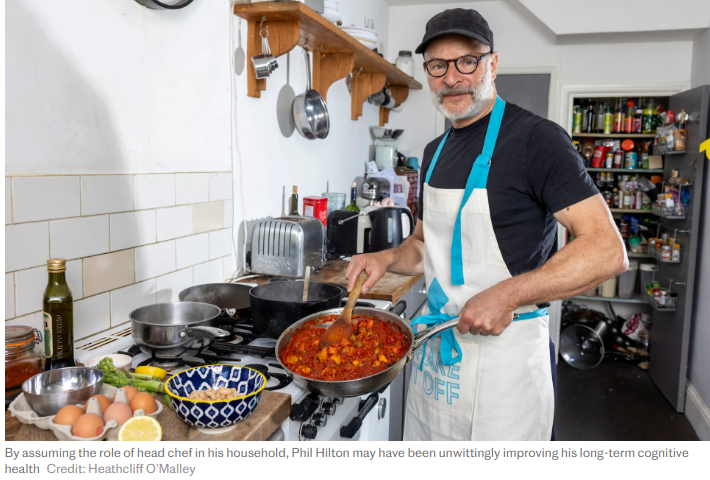
I wear the apron in my house. My tagliatelle ragù is a symphony in mince, and my griddled prawns transport you to the Amalfi Coast. My wife, you see, hates cooking. Now, it seems, despite my having taken up kitchen duties by default, I may have been unwittingly improving my long-term cognitive health.
New research carried out in Japan, and published in the Journal of Epidemiology & Community Health, suggests home cooking may reduce the risk of cognitive decline by 30 per cent, and that figure jumps to 70 per cent for novices learning for the first time. Participants in the study were at least 65 and drawn from the Japan Gerontological Evaluation Study, a long-term age-and-health-monitoring project.
Research led by Dr. Yukako Tani tracked over 10,000 older people for six years and concluded: “Creating an environment where people can cook meals when they are older may be important for the prevention of dementia.” Yet, there’s a danger men may be missing out.
Anne Iarchy is a cooking tutor at Age UK Barnet, she says, “Today most of the men on my courses have left cooking to their wives and when they find themselves on their own, they have no clue. They eat processed food and ready meals. They don’t know how to chop or peel a vegetable.”
These very arrangements may have saved the men time and effort, but cheated them of a simple everyday practice with huge cognitive benefits.
Here’s why it pays to cook at least once a week to protect your brain health.
Why frequent cooking means less chance of dementia
The details of the Japanese study are fascinating. The data showed that the more often subjects cooked, the lower their risk of dementia, but this differed according to the extent of their culinary skill.
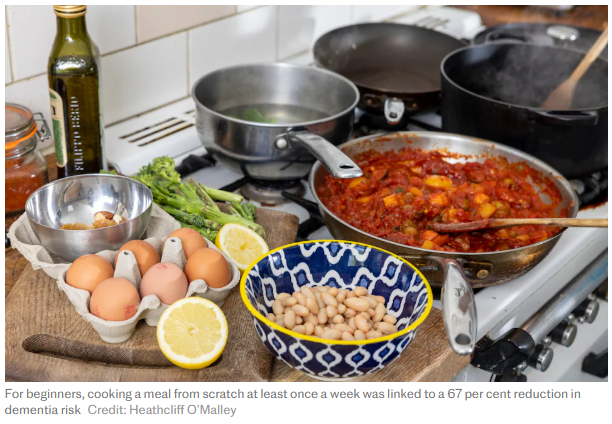
For the beginners, cooking a meal from scratch at least once a week was associated with a 67 per cent reduction in risk. For those who knew their way around a courgette, cooking from scratch once a week was associated with a 23 per cent lower risk of dementia in men and a 27 per cent lower risk in women.
Professor Catherine Loveday lectures in Cognitive and Clinical Neuroscience and Psychology at the University of Westminster. She says: “Cooking is a cognitively stimulating activity. It’s one of the basic real-world tests of executive function, which is the activity driven by the frontal lobes. It’s the facility that allows us to plan, use strategy, problem-solve, organise and time things.”
She says that cooking exercises different, key parts of the brain. “It is likely to stimulate and strengthen the prefrontal cortex, associated with decision-making, and the parietal cortex, which processes sensory information.” It also works the “basal ganglia, which is responsible for motor control, and the thalamus, which regulates consciousness, sleep and alertness”.
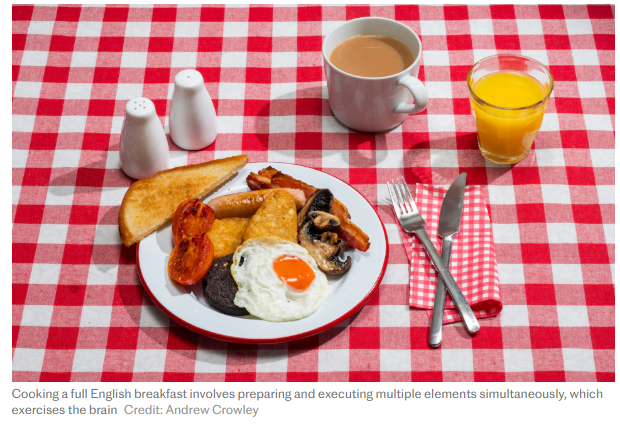
Prof Loveday cites the cognitive-high-bar of everyday food prep: the full English breakfast. “Cooking is a very executive task. Something like an English breakfast is a classic because there are so many things that have to be prepared in different ways and made ready at the same time. This means that you’re having to plan in a very strategic, timed way.”
In my experience, the full English breakfast is a performance meal. I’ve made it for a large group the morning after one of those rental-cottage debauches at which three (normally wholesome) families behaved like The Who on tour in the 1970s.
It appeared easy, and all the elements were straightforward, but as Loveday says, a lot more was happening cognitively than any of the hungry (and frankly ungrateful) diners imagined.
It’s the intricacy of the demands that may create the beneficial effect. “Increased task complexity is often thought to involve greater communication between the brain hemispheres and this is associated with better cognitive function in older age,” says Prof Loveday.
The very act of overseeing multiple cooking jobs simultaneously is a boon for your memory, says Prof Loveday. “Task-switching boosts brainpower by increasing neuroplasticity, strengthening neural connections and enhancing cognitive reserve. You’ve got to draw on your prior knowledge: how long does it take to cook this? What normally happens when I heat that? And there’s quite a lot of working memory demand.”
Working memory is the ability to hold a few things in your mind – such as mental arithmetic or taking directions – at once and juggle them. “It’s cognitively demanding in a way that’s a really good exercise for the parts of the brain that fail as we get older.”
And the good news is that “working memory is one of the more ‘trainable’ areas of cognitive function,” Prof Loveday says. A 2023 study carried out in China found that a combination of exercise and cognitive training had a significant effect on working memory in older people.
Not destroying the toast or drying out the beans requires yet another cognitive ability.
“There’s an element of control,” Prof Loveday says. “You are continually monitoring and adjusting, drawing on your own knowledge: normally you know how much cooking time sausages need but if they are smaller, they need less. That’s another cognitive skill: flexibility and having to adapt.”
Why it’s so important to keep cooking despite setbacks
There’s a tendency to take the task of cooking away from older people when they experience the first hints that the cognitive complexity may be a strain for them. Prof Loveday, who hosts the Mempathy podcast about dementia-related memory loss, says her mother, who suffers from dementia, revealed her first symptoms through cooking.
“The first thing that went wrong for my mum was that she went to cook a Christmas turkey. She’d done quite well, but she’d just forgotten to turn the oven on. Everything else was in place. That one mistake really threw her.”
She suggests that rather than giving someone with cognitive challenges a supply of effortless food, we facilitate their cooking, potentially turning it into a joint enterprise.
“Cooking can be collaborative; it can be something people do socially together. I even know people who cook together online. We know there’s an enormous amount of evidence that social connection is a tremendous buffer against cognitive decline.”
A richly rewarding element of the cooking process is sensory stimulation provided by the physical act of food prep. Professor Loveday has seen this in her work with dementia, “Smell and taste are both very evocative and can especially trigger nostalgic and comforting memories.
“We often find people telling us how they like to keep making dishes/meals that were cooked by parents and grandparents. Taste and textures, and even the look of a meal, are still able to evoke memories. One of the great things about food is that it is a multisensory experience [of] smell, taste, texture, vision (even sometimes hearing the crunch!), and this makes it particularly good at evoking memories.”
So what should we all be aiming for in the kitchen? “Cognitively, there is a sweet spot for all of us: sufficiently demanding, but not to the point where it is causing stress. It’s about finding that recipe that makes you think a little bit, but is not so complex that it feels stressful. Stress causes inflammation. Research shows that high levels of continued stress are not good for us. Find the right level for you – if you play a casual game of tennis, you don’t want to be playing Serena Williams.”
I’ve often found myself in a recipe rut, particularly as I, along with many men, tend towards a functional approach, ticking off essential nutrients and “efficient” use of time.
Prof Loveday supports the idea of a little experimentation, possibly a monthly challenge.
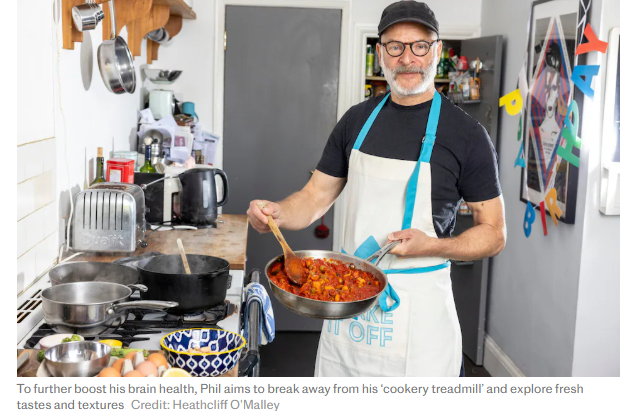
In the interests of my long-term cognitive health, I’m determined to break away from my cookery treadmill and explore fresh tastes and textures. Like all good middle-class homes, we own a varied collection of herbs, spices, pastes and exotic pickles that sit untouched most of the time. For the sake of my cognitive health, I’m determined to explore our amchoor, sumac and harissa stocks at least once a week. I just need to think of the right way to break this news to my wife.
The Best “Go Paid” Deal on Substack! You Get REAL Stuff!!

Go paid at the $5 a month level, and we will send you both the PDF and e-Pub versions of Etienne’s new book: To See the Cage Is to Leave It - 25 Techniques the Few Use to Control the Many and a coupon code for 10% off anything in the https://artofliberty.org/store/.
Go paid at the $50 a year level, and we will send you a free paperback edition of Etienne’s new book: To See the Cage Is to Leave It - 25 Techniques the Few Use to Control the Many OR “Government” - The Biggest Scam in History… Exposed! OR a 64GB Liberator flash drive if you live in the US. If you are international, we will give you a $10 credit towards shipping if you agree to pay the remainder.
Support us at the $250 Founding Member Level and get a signed high-resolution hardcover of “Government” - The Biggest Scam in History... Exposed! + Liberator flash drive + a signed high-resolution hardcover of Etienne’s new book: To See the Cage Is to Leave It - 25 Techniques the Few Use to Control the Many + everything else in our “Everything Bundle” of the best in voluntaryist thought delivered domestically. International pays shipping. Our only option for signed copies besides catching Etienne @ an event.


Comments ()